Knossos is the only major archaeological site in Greece where the most beautiful things you see are copies. The bull-leaping fresco glowing on the wall? A replica. The originals sit in a museum three miles away. That single fact explains why so many visitors leave the palace Knossos Crete underwhelmed while others call it the highlight of their trip.
The difference isn’t luck. It’s preparation. Knossos rewards visitors who understand what they’re looking at, arrive at the right hour, and treat the Heraklion Archaeological Museum as the other half of the same visit.
Key Takeaways
Frescoes on site are replicas; originals live in Heraklion’s museum
Combined ticket runs about €20 (roughly $22) for both
Arrive at 8 a.m. opening or after 4 p.m.
City bus No. 2 from Heraklion: 20 minutes, under €2
No maze exists; the labyrinth is pure myth
Budget a half-day, not a 45-minute stop
What You’re Actually Walking Into at Knossos
Knossos is the largest Bronze Age site on Crete: about 150,000 square feet of excavated palace complex spread across a low hill three miles south of Heraklion. It was the administrative and ceremonial center of Minoan civilization, occupied from roughly 1900 BC through its final destruction around 1350 BC.
There is no maze. There is no underground labyrinth. What you walk through is a dense warren of storerooms, light wells, staircases, and workshop spaces that once rose several stories.
That density is the point. The Minoans built vertically and around interior courtyards, so a ground-level visitor sees a confusing sprawl of low walls with occasional reconstructed sections rising above them.
The parts you should not miss
Four areas do the heavy lifting. The Throne Room, with its gypsum seat flanked by painted griffins, is the oldest throne room in Europe still in place. The Grand Staircase in the east wing shows the engineering most clearly, with its light well pulling daylight down through four levels.
The Royal Apartments include the Queen’s Megaron and its dolphin fresco. The west magazines hold rows of giant storage jars, called pithoi, some tall enough to hide an adult.
Who this visit suits
Cruise passengers docking at Heraklion for eight hours can do Knossos and the museum comfortably. Families with kids under 10 should know the site is uneven underfoot and strollers are a struggle.
If ancient architecture bores you, skip it and go to a beach. I’d rather tell you that honestly than have you spend $22 on a hot hillside you don’t enjoy.
Minos, the Minotaur, and What the Tablets Actually Say
The Minotaur myth is not evidence of anything found at Knossos. No bull-headed skeleton, no maze, no Theseus. The connection is cultural: the Minoans clearly venerated bulls, and Greek storytellers centuries later wove that into the tale of King Minos and his monster.
What archaeologists did find is more interesting.
Labyrinth likely derives from labrys, the double-headed axe, a Minoan religious symbol carved throughout the palace walls. The “house of the double axe” became, in Greek retelling, the maze no one could escape.
Linear A and Linear B
Two writing systems turned up in the palace archives. Linear B was deciphered in 1952 by Michael Ventris, who proved it recorded an early form of Greek — that discovery rewrote the timeline of Greek civilization.
Linear A, the older Minoan script, remains undeciphered. Nobody knows what language it records. Tablets from both systems are displayed in Heraklion, and they are mostly inventory lists: sheep counts, oil quantities, chariot wheels.
Why the bulls matter
The bull-leaping fresco shows three figures vaulting over a charging bull. Whether this was sport, ritual, or artistic exaggeration is still argued. Stone bull-horn sculptures, called horns of consecration, stand at the site’s south entrance.
Tell your kids the Minotaur story on the walk in. Then tell them the real one. The real one is better.
Arthur Evans’s Concrete: The Restoration That Splits Opinion
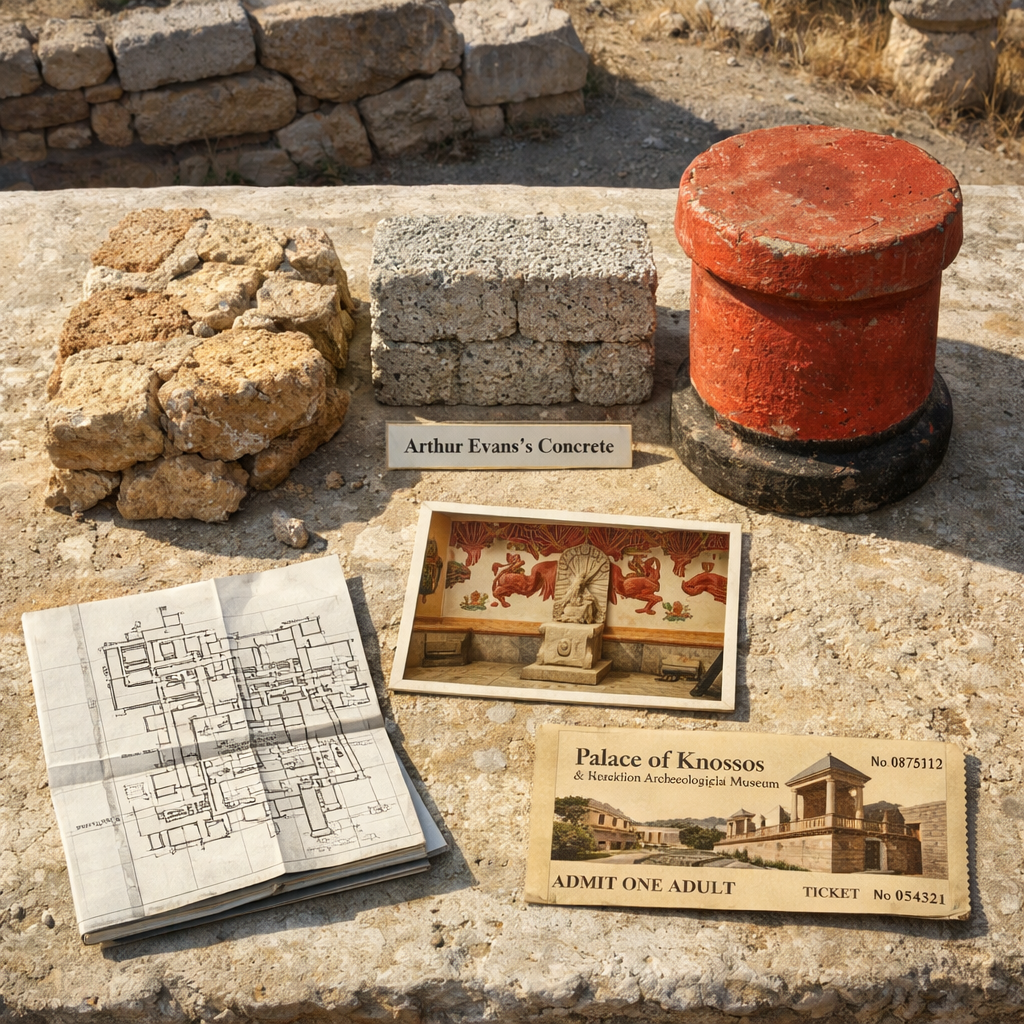
Sir Arthur Evans bought the site and began excavating in 1900. Over the next three decades he didn’t just dig — he rebuilt, pouring reinforced concrete columns, roofs, and floors, and commissioning painted reconstructions of fragmentary frescoes.
Purists have criticized this for a century. Evans guessed at details, painted tapering red columns based on thin evidence, and made the palace look more finished than any excavation could prove.
Here’s the case for him. Without the concrete, the upper floors would have collapsed entirely and you’d be looking at knee-high rubble like Phaistos. Evans’s reconstruction lets a non-specialist actually read the space.
What’s real and what isn’t
A practical rule: anything painted in bright color is a modern reproduction. The gypsum, limestone, and worn stone underfoot is genuine Minoan work. Concrete is obvious once you look for it — smooth, gray, and uniform.
The Throne Room’s alabaster seat is authentic. The griffin frescoes around it are painted copies of fragments found nearby.
How to look at it anyway
Treat the reconstructions as a three-dimensional diagram rather than a ruin. That reframing fixes most visitor disappointment.
Stand in the Central Court at the start. Face north. You’re looking down the same alignment Minoans used, and the mountain on the horizon was part of the sight line on purpose.
Tickets, Hours, and the Free-Entry Days Nobody Mentions
Buy the combined Knossos plus Heraklion Archaeological Museum ticket. It costs roughly €20 (about $22) versus €15 (about $17) for Knossos alone, and it’s valid for three days — so you can do the palace one morning and the museum the next.
The combined ticket is not issued automatically. You have to ask for it by name at the counter, or select it when booking online. Plenty of travelers pay twice because nobody told them.
Ticket
High season (Apr–Oct)
Low season (Nov–Mar)
Validity
Knossos only
~€15 / $17
~€8 / $9
Same day
Heraklion Museum only
~€12 / $13
~€6 / $7
Same day
Combined
~€20 / $22
~€10 / $11
3 days
Reduced rates apply to EU citizens under 25 and non-EU students with ID; children under 5 enter free. Non-EU seniors do not get the EU pensioner discount, which surprises a lot of American visitors.
Opening hours
Summer hours typically run 8 a.m. to 8 p.m., with the last entry 30 minutes before closing. Winter hours shrink dramatically, often 8 a.m. to 3:30 p.m. Greek state sites adjust these seasonally, so confirm the day before you go.
Free-entry days
Greece opens state archaeological sites free on set dates. These include March 6, April 18, May 18, the last weekend of September, October 28, and the first Sunday of each month from November 1 through March 31.
Free days are also the most crowded days. In winter that’s manageable. If your visit lands on one in shoulder season, get there at opening or don’t bother.
Getting From Heraklion to Knossos Without Overpaying
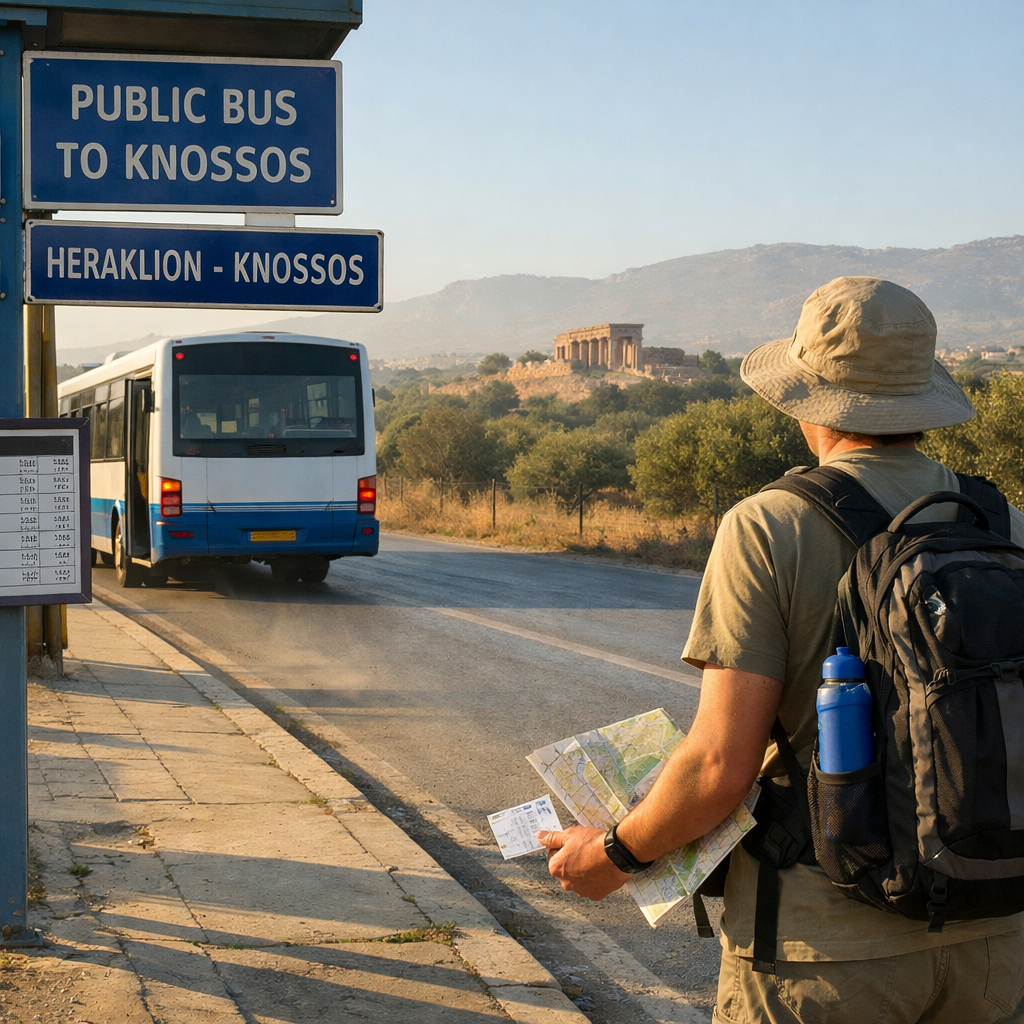
The city bus is the right answer for most people. Bus No. 2 runs from the Heraklion bus station near the port and stops on Eleftherias Square, reaching Knossos in about 20 minutes for under €2 (around $2) each way.
Buses run every 15 to 20 minutes in summer. Buy tickets at a kiosk before boarding — onboard fares cost more.
The realistic options, ranked
Bus No. 2 — cheapest, frequent, drops you at the entrance. Best for cruise passengers and anyone without a car.
Taxi — roughly €15–20 (about $17–22) one way from the center, 15 minutes. Worth it for a group of three or four.
Rental car — only if you’re touring the island anyway. Paid lots sit within a five-minute walk of the gate.
Organized tour with transport — covers pickup, guide, and skip-the-line entry in one booking.
Walking or cycling — three miles uphill on a busy road. I don’t recommend it.
Parking near the entrance fills by 10 a.m. in July and August. Arrive early or plan to park farther down the road and walk.
If you want to compare bus-versus-transfer-versus-guided-tour pricing for Heraklion side by side, mygreekpath.com lists the local transport and excursion options together, which saves some guesswork before you land.
Cruise passengers should note the port is about four miles from the site. A taxi from the cruise terminal takes 20 minutes in normal traffic and considerably longer when three ships dock together.
Beating the Crowds: Cruise Schedules, Heat, and the 4 p.m. Window
Two windows work: 8 to 9:30 a.m., or after 4 p.m. Cruise excursion coaches typically arrive between 9:30 a.m. and 1 p.m., and during that stretch the Throne Room viewing window backs up into a genuine line.
The site offers almost no shade. In July and August afternoon temperatures on the hill routinely climb past 95°F, and the stone radiates heat back at you.
What to bring
A hat, sunglasses, and at least a liter of water per person. Closed shoes with grip — the polished gypsum and worn stone get slippery. A small towel is not a bad idea.
There’s a cafe and restrooms near the entrance. Nothing inside the site itself.
Best months to go
May and early June, or late September into October. Temperatures sit in the 70s and 80s, and cruise traffic thins after mid-October.
Winter visits have real charm: green hills, almost no one there, and a €10 combined ticket. The trade-off is short hours and a decent chance of rain.
Guides, Audio Guides, and the Mistakes That Ruin Visits
A licensed guide is the single best upgrade at Knossos. Expect roughly €10–15 per person (about $11–17) for a group tour of 60 to 90 minutes, or more for a private guide. Licensed guides in Greece carry an official badge from the Ministry of Tourism — ask to see it.
Unlicensed “guides” hustling near the entrance are illegal and often wrong about basic facts.
Audio guides and a good phone app are decent budget alternatives. Site signage exists but is thin, and there’s no numbered route, so first-timers wander.
The five mistakes to avoid
Assuming the frescoes are original. They’re replicas; the originals are in Heraklion.
Looking for the labyrinth. It doesn’t exist and never did.
Skipping the museum. The palace makes far less sense without it.
Arriving at noon in August with no water.
Buying separate tickets when the combined one costs less.
Nearby Minoan sites worth adding
Phaistos, about 40 miles southwest, is the second-largest Minoan palace and has no concrete reconstruction at all — the contrast with Knossos is striking, and the Messara Valley views are excellent.
Malia sits 22 miles east and pairs easily with a beach afternoon. Zakros, at Crete’s far eastern tip, is a serious drive but rewards travelers who’ve already done the other three.
Do Knossos first. Everything else reads better afterward.
Conclusion
Do it in this order: book the combined ticket before you go, take bus No. 2 out for the 8 a.m. opening, spend two hours at the palace with a licensed guide, then head to the Heraklion Archaeological Museum that afternoon or the next morning while the ticket’s still valid.
Block out a half-day minimum. Knossos punishes the quick stop and pays back the prepared visitor.
Frequently Asked Questions
How long does a visit to Knossos take?
Plan 90 minutes to two hours on site, plus 40 minutes of round-trip transport from Heraklion. Add another 90 minutes for the museum. Guided tours run 60 to 90 minutes and usually leave you free to wander afterward.
Can you buy Knossos tickets at the gate?
Yes, but lines at the ticket window can run 20 to 30 minutes when cruise groups arrive. Online booking through the official Greek ministry portal or a tour operator lets you walk straight to the turnstile — worth it in high season.
Is Knossos wheelchair accessible?
Partially. A marked accessible route covers the Central Court and some western areas, but the Grand Staircase and upper levels involve stairs with no alternative. The surface is uneven gravel and stone throughout, so a companion helps considerably.
Should I visit Knossos or Phaistos if I only have time for one?
Knossos, without hesitation, especially for a first Minoan site. Phaistos is quieter and more authentically ruined, which appeals to repeat visitors, but it needs more imagination and there’s no public transport worth relying on.