About 2,500 years of Athenian life unfolded in the ancient agora of athens. This open archaeological site beside the Acropolis shows where citizens met, traded, debated, worshipped, and made decisions, giving you context that a rushed Acropolis visit cannot provide.
Allow at least 90 minutes, and closer to two hours if you want to see the Temple of Hephaestus and the Stoa of Attalos Museum properly. The site is more than scattered stones. It is one of the clearest places in Athens for understanding how ordinary civic life shaped classical Greece.
Key Takeaways
Allow 90 minutes to two hours
Visit the Stoa of Attalos Museum
See the Temple of Hephaestus
Check official hours before travelling
Walk from Monastiraki or the Acropolis
Wear shoes suitable for uneven ground
Why the Ancient Agora Matters More Than a Quick Photo Stop
The ancient Agora was the civic heart of Athens. It was a public space where people bought goods, attended legal business, met political leaders, followed religious processions, and discussed decisions affecting the city. The Acropolis shows Athens from above; the Agora shows how Athens worked at ground level.
Its history reaches back before the classical period and continued through Roman and later centuries. During the 5th century BC, Athens developed the political institutions associated with democracy, and the Agora became one of the places where that public life was visible.
The word agora means a gathering or marketplace, but the site was never only a shopping area. Administrative buildings, law courts, monuments, shrines, workshops, and meeting spaces filled the area around the main road.
Socrates and public debate
Socrates is closely connected with the public life of Athens. Ancient sources place his conversations in busy public areas, including places around the Agora, although modern visitors should not expect a marked “Socrates spot.” His importance here is the setting: ideas were discussed in public, among citizens and visitors, rather than inside a private academic campus.
Athenian democracy also had limits. Women, enslaved people, and resident foreigners did not enjoy the same political rights as male citizens. The Agora helps you understand both the achievement of Athenian democracy and the unequal society behind it.
A working city, not a stage set
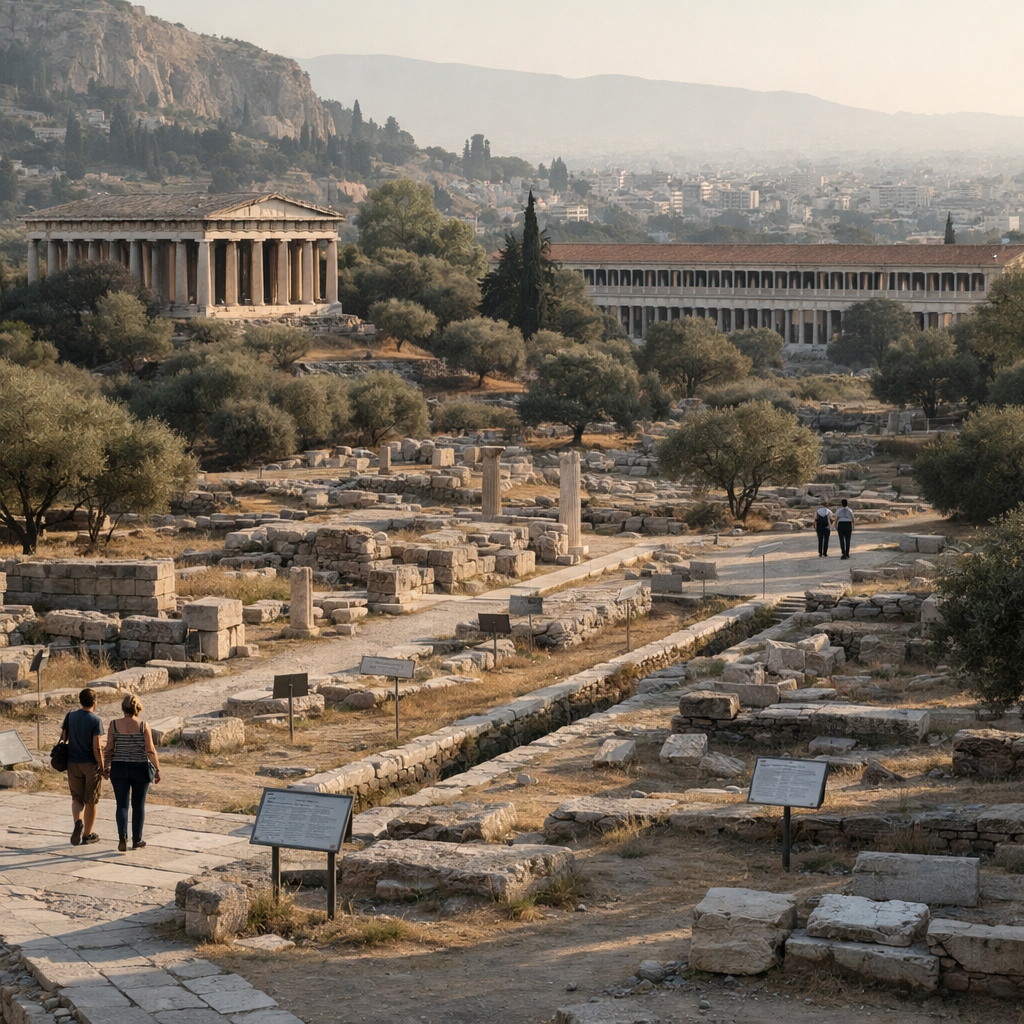
The remains include foundations, columns, roads, drainage features, and reconstructed buildings. Look beyond the most famous monuments. The layout explains how different activities fitted together, from trade and religious practice to civic administration.
That physical setting is the main reward. After the crowds and steep paths of the Acropolis, the Agora gives you room to slow down and connect the buildings with daily life.
What Should You See Inside the Archaeological Site?
See the Temple of Hephaestus first, then follow the paths through the Agora and reserve time for the Stoa of Attalos Museum. This order gives you the strongest first impression, covers the major surviving structures, and prevents the museum from becoming an afterthought.
The site is spacious by central Athens standards. Paths cross open ground, trees provide shade in some areas, and several remains are easier to understand from a distance than from beside a single wall.
Temple of Hephaestus
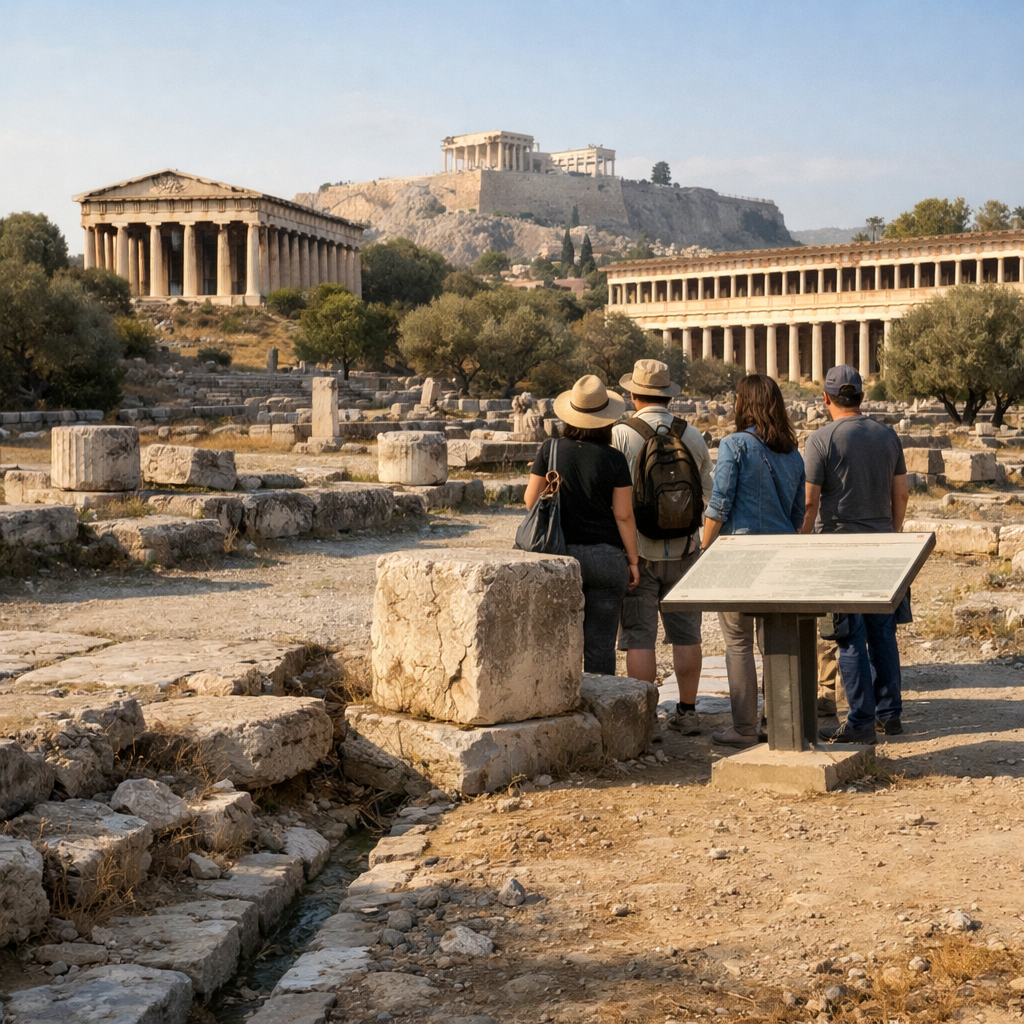
The Temple of Hephaestus is the best-preserved ancient temple in Athens. It stands on the hill known as Agoraios Kolonos and was built in the 5th century BC, during the same broad period as major building work on the Acropolis.
Its columns and roofline make it easier to imagine an ancient temple than many ruined structures elsewhere in the city. The temple was dedicated to Hephaestus, associated with metalworking, and Athena Ergane, associated with crafts.
Take time to walk around it rather than viewing only the front. The raised position gives you useful views across the Agora and toward the Acropolis, while the surrounding trees make this one of the more pleasant places to pause.
Stoa of Attalos Museum
The Stoa of Attalos is a long, reconstructed colonnaded building on the eastern side of the site. The present structure was rebuilt in the 20th century and houses the museum of the Ancient Agora.
Do not skip it. Displays of pottery, coins, inscriptions, sculptures, tools, and everyday objects explain what the foundations outside meant. Small objects often provide more direct evidence of ordinary life than monumental ruins do.
The museum also helps you understand Athenian democracy through objects connected with voting, public administration, and civic practice. Allow roughly 25 to 35 minutes inside, depending on your interest in ancient objects and inscriptions.
Other features worth finding
Look for the remains of civic buildings and monuments around the central area. The Bouleuterion was connected with the council that prepared business for the citizen assembly, while the Tholos was associated with officials who carried out public duties.
The exact appearance of many structures remains partial, so use the site signs and museum displays together. A line of foundations becomes far more meaningful when you know whether it belonged to a court, office, shrine, or market building.
How Long Do You Need, and When Should You Go?
Plan 90 minutes for the main route and two hours for a relaxed visit with the museum. A rushed 45-minute walk is enough to see the temple from outside, but it removes the context that makes the ancient Agora of Athens worth visiting.
Morning is the best choice during the hot months, especially from June through September. The site has open areas and stone surfaces that become tiring under strong midday sun. Late afternoon can also work when opening hours allow it, but check the closing time before setting out.
A practical two-hour route
Use this sequence:
Enter and check the site map.
Walk toward the Temple of Hephaestus.
Explore the central Agora remains and civic buildings.
Visit the Stoa of Attalos Museum.
Return slowly through the eastern and southern paths.
Stop for the Acropolis views before leaving.
This route keeps the major sights together without sending you back and forth across the grounds. It also places the museum after you have seen the ruins, so the objects answer questions raised by the outdoor visit.
Heat, shade, and footwear
Wear walking shoes with firm soles. The ground can include uneven stone, dust, and slopes, and comfortable sandals with weak grip are a poor choice after rain or during a long Athens walking day.
Carry water, especially in July and August. A small bottle is more useful than relying on finding refreshments inside the archaeological site, where services can be limited compared with the streets around Monastiraki.
Shade exists, but it is not continuous. A hat and sunscreen are sensible, and a light layer helps during spring or autumn mornings when the temperature changes between sunny and shaded areas.
Why slower beats faster here
The Agora rewards interpretation. You need time to compare the museum objects with the buildings outside and to notice how the site sits between the Acropolis, Monastiraki, and the modern city.
If your itinerary already includes the Acropolis Museum and the Acropolis, the Agora is the place to reduce your pace. It gives your day a different rhythm instead of adding another crowded viewpoint.
Tickets, Opening Hours, and Entry Planning
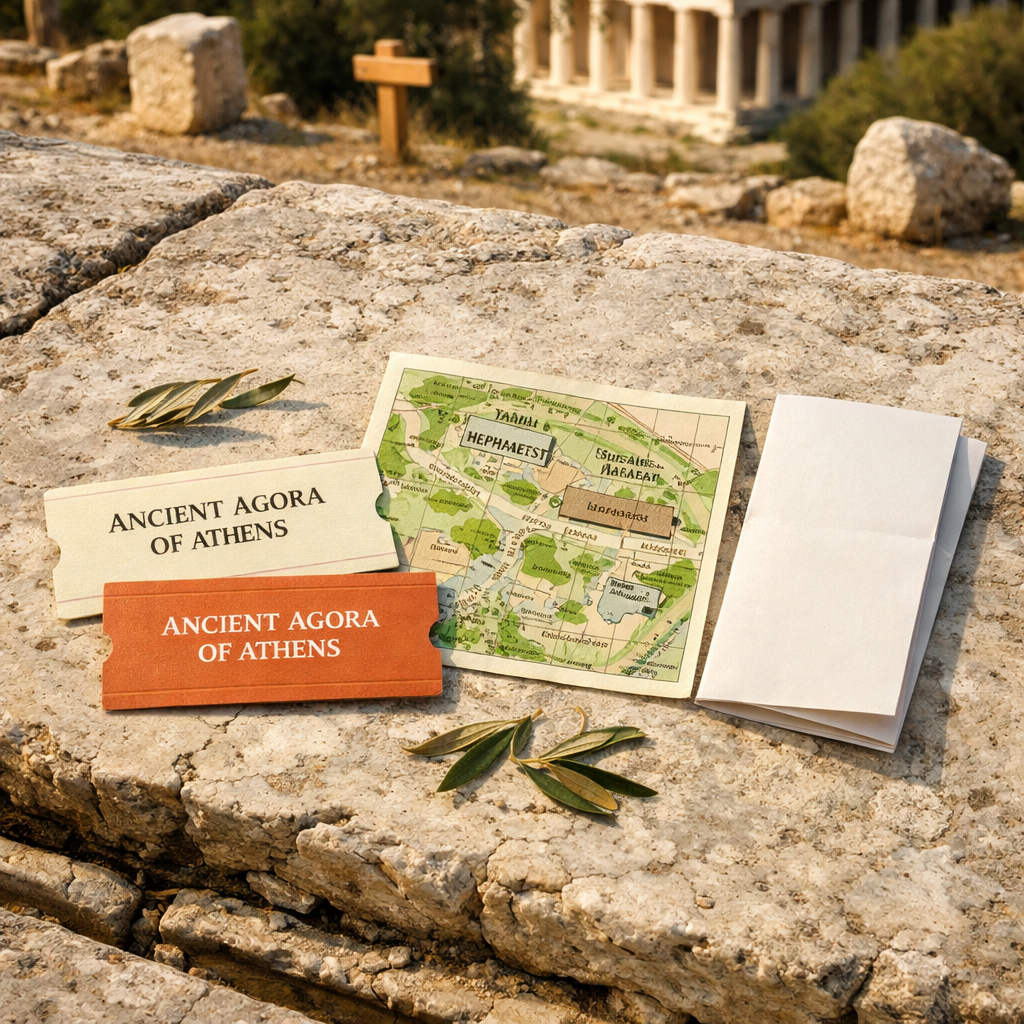
Check the official Greek Ministry of Culture information shortly before your visit for current opening hours, admission prices, seasonal changes, and entrance conditions. These details change, and old travel pages often continue showing prices or hours that no longer apply.
The Agora is a separate archaeological site from the Roman Agora. They are both near Monastiraki, but they are different places with different entrances and visiting experiences. Do not assume that a ticket for one automatically covers the other.
Choosing your ticket
Some visitors buy an individual ticket for the Ancient Agora, while others use a combined archaeological-site ticket when available and suitable for their itinerary. The right choice depends on how many included sites you will actually visit.
Before paying, compare the current individual price with the current combined option. If your plan includes the Acropolis, Roman Agora, Hadrian’s Library, and other listed sites, a combined ticket may offer better value. If you only have time for one or two places, an individual ticket is simpler.
Do not plan around an old online price. Use the official ticket information for the season and date of your visit.
Best time to confirm details
Recheck the information 24 to 48 hours before going, particularly around public holidays, heat-related schedule changes, and winter opening periods. The site may close earlier than expected outside the main summer season.
A same-day check also tells you which entrance is operating and whether ticket sales have limits. This matters when you are connecting the visit with a timed Acropolis entry or a train from Athens International Airport.
Where to buy
Use the official ticket channel or the site’s authorized ticket office. Third-party tours can be useful when you want a guide, but compare what the price includes: admission, transport, commentary, and the length of the visit are separate elements.
For a self-guided visit, download or save the official information before entering. Mobile reception may be weaker in parts of the site, and you will enjoy the ruins more when you are not searching for basic details at every stop.
How Do You Reach the Ancient Agora of Athens?
The easiest approach is on foot from Monastiraki, where the Agora is a short walk from the station and the surrounding market streets. From the Acropolis area, follow the pedestrian routes toward Thissio and the Agora rather than taking a taxi for a journey that is often quicker on foot.
Athens Metro lines 1 and 3 serve Monastiraki station, making it practical for visitors staying in central Athens or arriving from other parts of the city. Thissio station on Line 1 is also convenient for the western side of the archaeological site.
From Monastiraki
Walk west from Monastiraki Square toward Adrianou Street and the archaeological area. The route passes cafés, shops, and busy pedestrian sections, so leave extra time if you are travelling with luggage or a pushchair.
The walk is manageable, but the paving can be uneven and crowded. Keep valuables secure in busy streets, especially around the market and station, and do not let the short distance make you rush.
From the Acropolis
The Agora fits naturally after the Acropolis or Acropolis Museum. A walking route through the historic center usually takes around 15 to 25 minutes, depending on your starting point and how often you stop.
This combination works well because the two sites answer different questions. The Acropolis presents religious and political symbolism on the hill; the Agora shows the public spaces below where citizens conducted much of city life.
By taxi or private transfer
A taxi is useful for visitors with limited mobility, heavy bags, or accommodation outside central Athens. Ask to be dropped near the correct entrance and confirm that the driver understands you mean the Ancient Agora, not the Roman Agora.
The distinction matters. Both sites are central, but arriving at the wrong one wastes time and may leave you walking uphill or through crowded streets in the heat.
Planning around other Athens stops
Combine the Agora with Monastiraki, Plaka, the Acropolis Museum, or Thissio. Avoid placing it between two distant attractions with fixed entry times, because the site is more enjoyable when you can stay until you have seen the museum.
For hotels and airport transport, compare location and transfer options before booking. My Greek Path can help you review Athens accommodation and travel services in one place, which is useful when a central address changes how easily you reach the historic sites.
Accessibility and Practical Advice for a Better Visit
The Ancient Agora is accessible in parts, but it is not a completely level modern attraction. Uneven archaeological surfaces, slopes, gravel, and steps affect movement, so visitors using wheelchairs or with limited mobility should check the current accessibility information before travelling.
Staff and official visitor information can clarify the most suitable route. Conditions may also change after rain, maintenance, or site works, making a current check more reliable than a generic guide written years ago.
For visitors with limited mobility
Plan around the most accessible paths and ask about access to the museum before buying your ticket. The Temple of Hephaestus sits on raised ground, so reaching its closest viewpoints may be harder than exploring the lower parts of the Agora.
A companion can make the visit easier, especially when navigating uneven ground. If mobility is a serious concern, a private transfer to the nearest practical entrance reduces the effort before the visit begins.
For families
Children usually respond better to a simple mission than to a long history lecture. Ask them to find the temple, identify a coin or inscription in the museum, and look for the open space where public business took place.
Allow a break after the first 45 minutes. The site is open and interesting, but summer heat and limited shade can reduce attention quickly. A visit before lunch often works better than one in the hottest afternoon hours.
For independent exploration
Read the site map before walking. Then use the museum as your explanation centre rather than treating it as an optional final room.
A licensed guide is worth considering if ancient Athenian politics, architecture, or archaeology is a main reason for your trip. Otherwise, clear signage, a reliable guidebook, and two unhurried hours give you enough structure for a rewarding self-guided visit.
Common mistakes to avoid
Do not confuse the Ancient Agora with the Roman Agora. Do not assume the ruins explain themselves without the museum. Do not rely on opening hours copied from an old blog, and do not arrive without water during a hot August afternoon.
Most visitors regret rushing, not spending too much time. The Agora is one of the rare central Athens sites where slowing down improves the experience.
Ancient Agora or Roman Agora: Which Should You Visit?
Choose the Ancient Agora if you want the fuller historical experience, better museum context, and a larger site connected with Athenian civic life. Choose the Roman Agora if you have limited time and want a compact monument near Monastiraki, especially the Tower of the Winds.
The two sites are close enough to confuse first-time visitors, but their roles differ. The Ancient Agora developed as the main civic and commercial centre of Athens, while the Roman Agora was built later as a more formal marketplace during the Roman period.
The Roman Agora can fit into a short walk of roughly 30 to 45 minutes. The Ancient Agora needs longer because the grounds are larger and the Stoa of Attalos Museum adds real depth.
Choose the Ancient Agora when…
You want to understand democracy, public debate, trade, law, and everyday civic life. It is also the better choice when you have at least 90 minutes and want a quieter site with more space than the busiest Acropolis viewpoints.
The Temple of Hephaestus is another strong reason to choose it. Its preservation gives you a clear architectural reference point for the wider ancient landscape around Athens.
Choose the Roman Agora when…
Your itinerary is packed, you are already near Monastiraki, or you are especially interested in Roman-era Athens. Its smaller scale makes it easier to add between lunch and another central-city stop.
Do not describe the Roman Agora as a substitute for the Ancient Agora. It answers a different historical question and does not provide the same museum experience.
Visit both if your schedule allows
A combined historic-center walk can include the Ancient Agora, Roman Agora, Hadrian’s Library, Monastiraki, and the Acropolis area. Leave several hours for the route, including pauses and food.
The best order depends on your timed bookings. If the Acropolis entry is fixed, place the Agora before or after it according to heat, energy, and the official closing time on that date.
Conclusion
Book the Ancient Agora for a slower part of your Athens day, not as a ten-minute stop between landmarks. Choose it over the Roman Agora when you want civic history, the Temple of Hephaestus, and the Stoa of Attalos Museum. Check official hours and admission 24 to 48 hours before visiting, then allow two hours and carry water.
Frequently Asked Questions
Is the Ancient Agora of Athens worth visiting?
Yes, especially if you want to understand how ordinary civic life worked in classical Athens. The Temple of Hephaestus and Stoa of Attalos Museum make the visit worthwhile even for travellers with only half a day in the historic center.
Can you visit the Ancient Agora and Acropolis on the same day?
Yes, but allow several hours between them rather than planning back-to-back entries. The walk between the areas is practical, while heat, crowds, and the Agora’s 90-minute minimum visit can make a tight schedule uncomfortable.
Is the Ancient Agora suitable for a rainy day?
It is still visitable, but rain makes stone paths and uneven ground more slippery. The Stoa of Attalos Museum provides useful indoor time, although it does not replace the outdoor experience, so wear shoes with firm grip.
Where is the main entrance to the Ancient Agora?
The site has entrances around the historic center, with access commonly approached from Adrianou Street near Monastiraki and from the Thissio side. Check the official information on your visit date because operating entrances can change.