Museums of Athens: A Practical Guide to the City’s Best
A 90-minute visit can be enough for one focused museum, while a full day may still feel short at the Acropolis Museum and National Archaeological Museum. Choosing among the museums of Athens is less about finding one universal “best” museum and more about matching the collection to your time, interests, and sightseeing route.
Athens works well for museum planning because its major collections sit in a few walkable areas. You can pair the Acropolis Museum with the ancient citadel, place Benaki Museum near Syntagma Square, or explore Monastiraki and the Ancient Agora without crossing the city repeatedly.
Key Takeaways
Acropolis Museum: best first choice for most visitors
National Archaeological Museum: deepest ancient collection
Benaki: broad Greek history in one central building
Allow 90 minutes to three hours per major museum
Museum tickets do not automatically include archaeological sites
Check official hours before visiting on Monday
Start With Your Time, Not a Generic Ranking
The Acropolis Museum is the strongest choice for a first Athens visit of two or three days. Its displays explain the monuments on the Acropolis, and its location in Makryianni makes it easy to combine with the Parthenon area, Plaka, and the pedestrian streets around Dionysiou Areopagitou.
If you have about 90 minutes, choose one focused museum rather than forcing two large collections into the same morning. The Museum of Cycladic Art works well for ancient art and a quiet central location. The Museum of Ancient Agora fits travelers already walking through the archaeological site.
A four-day trip gives you room for two major museums and one smaller collection. I’d usually pair the Acropolis Museum with either the National Archaeological Museum or Benaki Museum, then add the Byzantine and Christian Museum if medieval and religious art interests you.
The best museum depends on your route. A museum that requires a 30-minute transit ride each way may be a poor choice before a timed Acropolis entry, even if its collection is stronger for your interests.
Use this simple match:
First Athens trip: Acropolis Museum.
Ancient history enthusiast: National Archaeological Museum.
Broad Greek history: Benaki Museum.
Medieval art and churches: Byzantine and Christian Museum.
Modern Greek history: National Historical Museum.
Short central-city visit: Museum of Cycladic Art.
The mistake is treating every museum as a full-day attraction. Most travelers get more from one large museum and one smaller one than from three major collections in succession.
The Main Museums of Athens Compared
Athens has several museums with different scales and purposes. The table below uses practical planning estimates for visit length, not official tour times. Ticket prices and hours change, so confirm them on each museum’s official website before your visit.
The Acropolis Museum ticket is not an Acropolis archaeological-site ticket. They are separate attractions, with separate entrances and ticket rules. Plan them as two connected visits, not as one admission.
The National Archaeological Museum has the broadest ancient collection on this list, from prehistoric objects through later periods of Greek antiquity. Its size is also its limitation. A two-hour visit requires a plan, such as choosing the Mycenaean, sculpture, or Egyptian galleries instead of wandering through every room.
Benaki Museum is a better fit when your interest extends beyond classical Greece. Its collection moves through several periods of Greek culture, so it gives you historical range without requiring a trip to the National Archaeological Museum’s larger northern location.
“A museum is a not-for-profit, permanent institution in the service of society…” — International Council of Museums, museum definition adopted in 2022
That definition helps explain why these places feel different from archaeological sites. Museums organize objects indoors, add labels and conservation, and create a sequence that helps visitors compare periods. The Ancient Agora itself shows a place; its museum explains objects found there.
Which Museum Fits Your Travel Style?
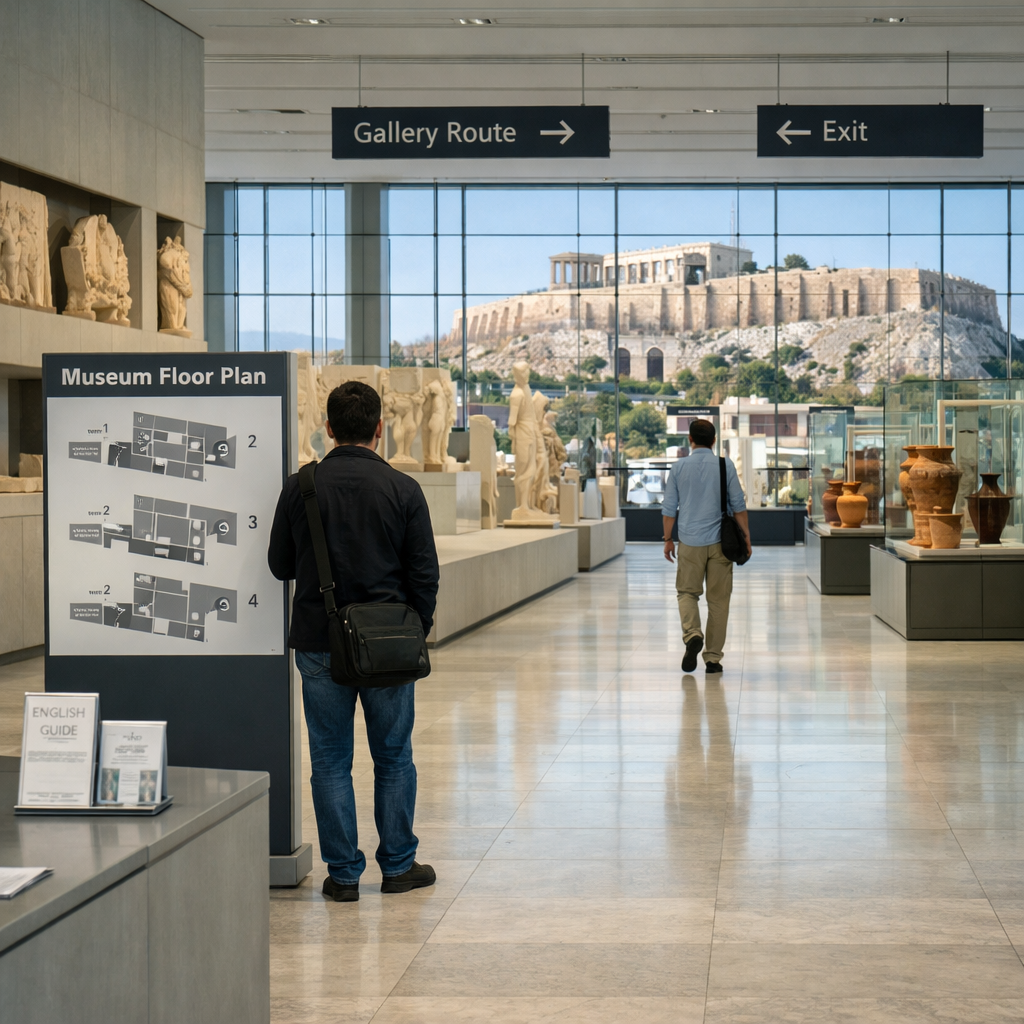
A traveler focused on famous landmarks should begin with the Acropolis Museum. Its glass galleries, Parthenon sculptures, and views toward the Acropolis connect directly with the monument you have probably already planned to see.
For first-time Athens visitors
The Acropolis Museum gives the clearest context for the Acropolis archaeological site. The upper gallery is especially useful because its arrangement follows the Parthenon’s sculptural program, while the building’s position makes the relationship between the museum and hill easy to understand.
Arrive before or after your Acropolis visit, but leave enough energy for both. Walking uphill in Athens heat, then spending two hours reading labels and viewing sculpture, is more tiring than many itineraries assume.
For ancient-history specialists
Choose the National Archaeological Museum if you want breadth and depth. Its collections include prehistoric artifacts, sculpture, pottery, metalwork, and Egyptian and Near Eastern material, making it the strongest option for visitors who want more than the Acropolis story.
The museum rewards a selective route. For example, you could spend 45 minutes on Mycenaean objects, 60 minutes on sculpture, and another 30 minutes on a smaller group of galleries instead of trying to see everything.
For art and design interests
The Museum of Cycladic Art is the most focused choice. Its famous marble figures are only part of the appeal; the museum also explains Cycladic culture and places ancient objects in a carefully designed setting.
Benaki Museum works better for travelers who want Greek art and history across centuries. Its Kolonaki location also makes it easy to combine with the National Garden, Syntagma Square, or the Museum of Byzantine Culture nearby.
For modern and medieval Greece
The Byzantine and Christian Museum focuses on religious art, icons, manuscripts, sculpture, and objects from the Byzantine and post-Byzantine periods. It is a better choice than the Acropolis Museum for visitors interested in how Christianity shaped Greek art and public life.
The National Historical Museum covers later Greek history, including the War of Independence and the development of the modern Greek state. Its setting in the Old Parliament building adds context, but travelers should check current access arrangements because historic buildings sometimes have changing visitor routes.
Athens Museum Neighborhoods Make Planning Easier
The most efficient Athens museum itinerary follows neighborhoods. Grouping visits reduces backtracking, protects your energy, and leaves more time for food, walking, and major landmarks.
Makryianni and Plaka
The Acropolis Museum sits south of the Acropolis in Makryianni. From there, you can walk toward Plaka, Anafiotika, the Roman Forum, or Monastiraki. This area is the easiest place to build a museum-and-landmark day.
A practical sequence is the Acropolis archaeological site in the morning, lunch in Plaka, and the Acropolis Museum in the afternoon. Reverse the order if the museum’s available entry time fits better.
Kolonaki and central Athens
Benaki Museum and the Museum of Cycladic Art are both in the Kolonaki area, close to Syntagma and the National Garden. They are near enough to combine, but two museums still require a realistic time budget.
For most visitors, choose one. Add a second only if both collections match your interests and you are comfortable spending roughly four hours indoors, including the walk, a break, and security procedures.
Monastiraki and the Ancient Agora
The Museum of Ancient Agora is the natural choice after visiting the Ancient Agora archaeological site. The building is the Stoa of Attalos, reconstructed in the 1950s, and its objects explain how the civic center functioned.
This pairing has a useful rhythm: outdoor ruins first, shaded indoor galleries second. In July or August, that order can make the afternoon easier because the museum provides a break from direct sun.
Victoria and Exarcheia
The National Archaeological Museum is north of the central tourist core, near Victoria. It is reachable by metro and is worth the extra journey when ancient history is your main reason for visiting Athens.
Do not place it between the Acropolis and an evening reservation across town. Its large galleries can absorb more time than planned, and the return journey adds a fixed travel cost even when the museum visit goes smoothly.
Tickets, Hours, and Entry Rules Need Checking
Museum tickets and opening hours change by season, exhibitions, holidays, and government policy. The safest approach is to check the official website shortly before your visit, especially for Monday plans and travel dates in April, July, or October.
The Acropolis Museum and the Acropolis archaeological site use separate admissions. A combined archaeological-site ticket, when available under current rules, does not automatically mean museum entry. Read the product name carefully before paying.
Mondays are a common trap
Assuming every museum is open on Monday is a planning mistake. Many cultural institutions close one day each week, and Monday is a frequent closure day, although schedules differ.
If Monday is your museum day, verify each destination individually. Keep a walking route, market visit, or outdoor landmark as a backup rather than discovering at 10 a.m. that your first choice is closed.
Timed entry and arrival buffers
Some museums use timed tickets during busy periods, while others allow general entry. A timed ticket controls when you enter, not how long you may stay, so arrive with enough time for the walk and security check.
For a 10 a.m. entry near the Acropolis, I’d leave a 20- to 30-minute buffer after your expected arrival in the neighborhood. Athens traffic, confusing side streets, and a delayed metro connection can quickly erase a narrow schedule.
Prices are not permanent
Avoid building your budget around an old blog post. Ticket prices, free-entry dates, reduced categories, and special exhibition charges can change without matching older travel guides.
Carry a payment card and a small amount of cash. Also bring a student or age-based eligibility document if you plan to request a reduced ticket; acceptance depends on the institution and the current policy.
How Long Should You Spend Inside?
For most visitors, 90 minutes is enough for a focused smaller museum, while large collections need two to four hours. The right length depends on whether you want a quick orientation, a careful visit, or time for temporary exhibitions and a museum café.
A useful planning rule is to schedule one major museum per half day. That leaves space for walking and lunch, and it prevents the common problem of looking at important objects without absorbing them.
A two-day example
On day one, visit the Acropolis archaeological site in the morning and the Acropolis Museum later. On day two, choose either the National Archaeological Museum or Benaki Museum, then spend the evening in the central neighborhoods.
This plan works because each day has one main indoor focus. If you add the Museum of Ancient Agora to day one, keep it short and treat it as part of the archaeological-site route rather than a second major museum.
A three- to four-day example
With more time, combine the National Archaeological Museum with the Museum of Cycladic Art on separate days. Add the Byzantine and Christian Museum if medieval art interests you, or the National Historical Museum if modern Greek history matters more.
A four-day itinerary can support three or four museums without feeling like a checklist. Leave one flexible afternoon for a temporary exhibition, a closed museum, or weather that changes your outdoor plans.
When a short visit is better
If you have a cruise stop or a single free afternoon, choose the museum closest to your other plans. The Acropolis Museum is the obvious option near the Acropolis, while Benaki or Cycladic Art fits a Syntagma and Kolonaki route.
A short visit should have a target. Decide in advance that you will see the Parthenon Gallery, the Cycladic figures, or a specific sculpture group. Focus creates a better experience than racing through 20 galleries.
Common Planning Mistakes and Their Limits
The most famous museum is not automatically the right museum for a short Athens itinerary. A traveler with one afternoon may gain more from the Museum of Cycladic Art than from spending most of that time commuting to and navigating the National Archaeological Museum.
A second mistake is assuming that an archaeological-site ticket covers every nearby museum. Athens groups attractions geographically, but the ticketing systems remain separate. Confirm exactly what your receipt includes before entering the Acropolis Museum or Ancient Agora Museum.
Crowds change the experience
The Acropolis Museum can become busy around midday, particularly during the main summer travel season. The National Archaeological Museum is spacious, but its entrance, café, and popular galleries can still become congested.
Early entry often improves comfort, but it does not guarantee an empty building. A weekday morning outside a major holiday period usually offers a calmer visit than a Saturday afternoon in July.
Heat affects museum choices
Athens summers are hot, and walking between museums in direct sun takes more energy than a map suggests. Temperatures above 90°F are common during summer afternoons, so place outdoor sites earlier and use a museum as a midday pause.
In cooler months, the balance changes. You can spend more time walking between Plaka, Monastiraki, and the Ancient Agora without needing a long indoor break.
Smaller museums can be the better answer
The National Archaeological Museum has greater scale, but scale is not the same as suitability. If you have a specific interest in Cycladic art, Byzantine icons, or modern Greek history, a smaller specialist collection may give you more useful context in less time.
Check temporary closures and gallery access before committing. Restoration work can remove a collection’s most anticipated object from display, and a museum’s online notice is more reliable than a guide printed years earlier.
A Practical Route for Your Athens Museum Day
A well-built museum day has one anchor, one optional addition, and a clear stopping point. Start with the museum that best matches your interest, then add a nearby collection only if your energy and opening hours allow it.
For a first-time visitor, I’d choose the Acropolis Museum as the anchor. Afterward, walk through Plaka or the Ancient Agora area instead of immediately taking transportation to another large museum.
Route A: Acropolis and ancient Athens
Begin at the Acropolis archaeological site, allowing roughly two hours for the hill and monuments. After a break, spend two to three hours at the Acropolis Museum, then walk downhill toward Plaka and Monastiraki.
This route keeps related subjects together. The site shows the monuments in place; the museum provides the sculpture, archaeological evidence, and interpretation that the open-air ruins cannot supply.
Route B: Central art and history
Choose Benaki Museum or the Museum of Cycladic Art in the morning, take lunch around Kolonaki or Syntagma, and continue to the National Garden or the National Historical Museum. This route avoids the long trip to Victoria.
Pick Benaki for historical range. Pick Cycladic Art for a shorter, more specialized visit. Trying to complete both plus the National Historical Museum in one day leaves little room for a proper break.
Route C: Ancient Agora and Monastiraki
Visit the Ancient Agora early, then enter the Museum of Ancient Agora inside the Stoa of Attalos. Continue through Monastiraki for lunch and the flea market, with the Roman Forum or Hadrian’s Library as optional stops.
This is the best route for travelers who want to understand how ordinary civic life worked in ancient Athens. It is less demanding than combining the Agora with the National Archaeological Museum on the same day.
Route D: A museum-only day
If rain, heat, or personal interest makes indoor sightseeing the priority, choose one large museum and one smaller collection. For example, spend the morning at the National Archaeological Museum and the late afternoon at the Museum of Cycladic Art.
Keep at least 45 minutes between the planned end of one visit and the next fixed commitment. That gap covers transit, food, restroom stops, and the possibility that one gallery holds your attention longer than expected.
The practical goal is a day you can remember, not a list you can complete.
Conclusion
Choose the Acropolis Museum if this is your first Athens trip. Choose the National Archaeological Museum for depth, Benaki for broad Greek history, and a specialist museum when your interests are specific. Before booking, check the official hours, confirm separate tickets, and build your day around one major collection rather than three rushed visits.
Frequently Asked Questions
Are Athens museums free on certain days?
Some museums offer free admission on designated cultural days or under specific age and student categories, but dates and eligibility vary. Check the museum’s official ticket page for your travel month rather than relying on a general Athens pass or an old guide.
Can I visit the Acropolis Museum and Acropolis in one day?
Yes, and combining them is usually the most logical plan. Allow roughly two hours for the archaeological site, a break for food or water, and two to three hours for the museum; timed entry and seasonal crowds can lengthen the day.
Which Athens museum is best for children?
The Acropolis Museum is often the easiest first choice because the galleries connect to a landmark children can see from the building. Keep the visit focused, use the family resources available that day, and avoid scheduling another large museum immediately afterward.
Is the National Archaeological Museum worth the trip from central Athens?
It is worth the trip if ancient Greek art is a main interest, especially for visitors who want sculpture, prehistoric objects, and collections beyond the Acropolis. If you have only one afternoon, a central museum may fit your schedule better.