104 Corinthian columns once formed the Temple of Olympian Zeus, but only 15 remain standing today. That contrast makes the athens zeus temple a quick, rewarding stop rather than a full-day attraction, especially when you pair it with Hadrian’s Arch or the Acropolis.
The Olympieion sits in central Athens, close to Syntagma, Plaka, and the National Garden. You get ancient scale, Roman history, and strong Acropolis views without spending hours inside a large museum or archaeological complex.
Key Takeaways
15 standing columns remain from the original 104
The site works best as a 30–60-minute stop
Hadrian’s Arch is just outside the archaeological grounds
Check official opening hours and prices before visiting
Combine the Olympieion with the Acropolis or Plaka
Metro, tram, and walking routes all serve the area
What Is the Athens Zeus Temple?
The Athens Zeus Temple is the Temple of Olympian Zeus, also called the Olympieion. It is a large ancient site south-east of the Acropolis, near Hadrian’s Arch and the National Garden. The temple was dedicated to Zeus, the chief god of ancient Greek religion, and its surviving columns show how enormous the finished Roman-era building was.
The temple is not the Parthenon. The Parthenon stands on the Acropolis hill and was dedicated to Athena, while the Olympieion was built on flatter ground for Zeus. From the temple grounds, you can look toward the Acropolis and understand how these two major monuments fitted into the ancient city.
The site is compact. Most visitors need about 30 to 60 minutes, depending on how long they spend reading the information panels, taking photographs, and viewing the remaining ruins from different angles.
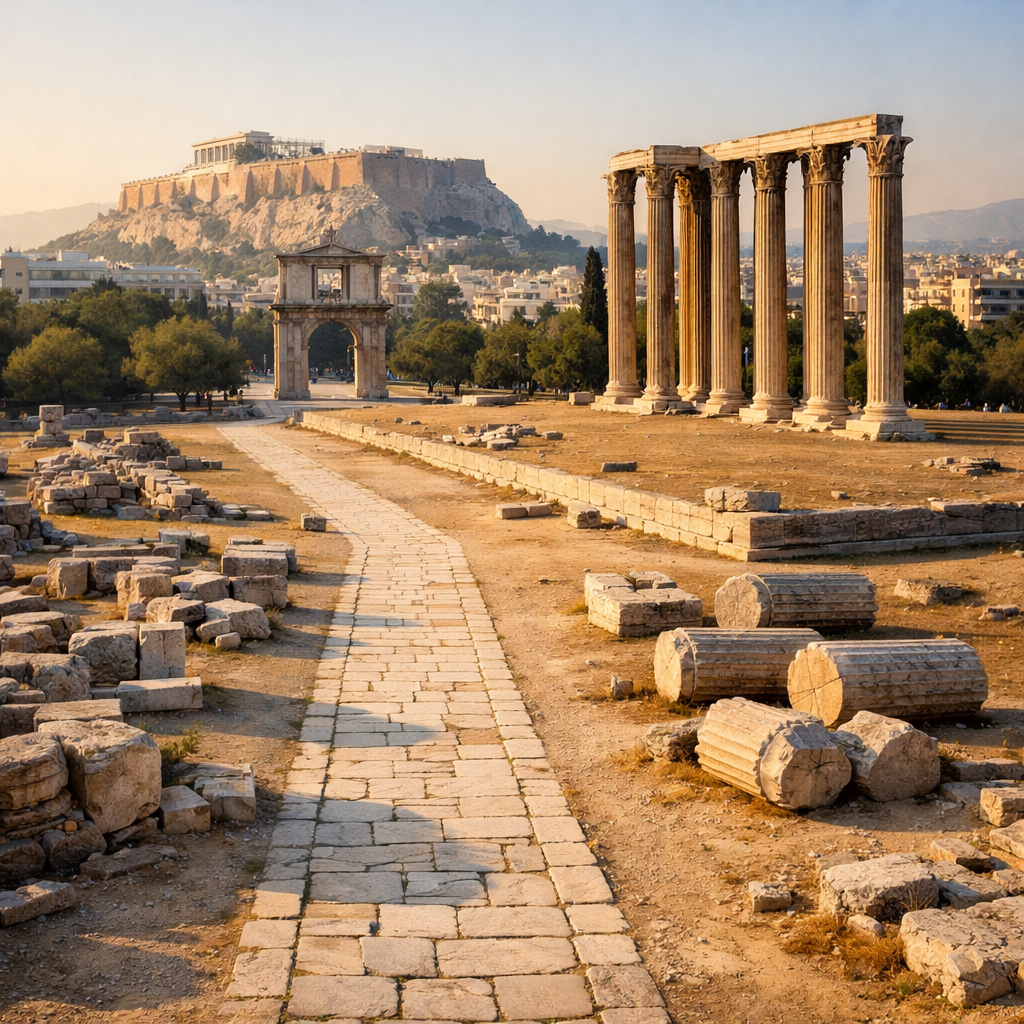
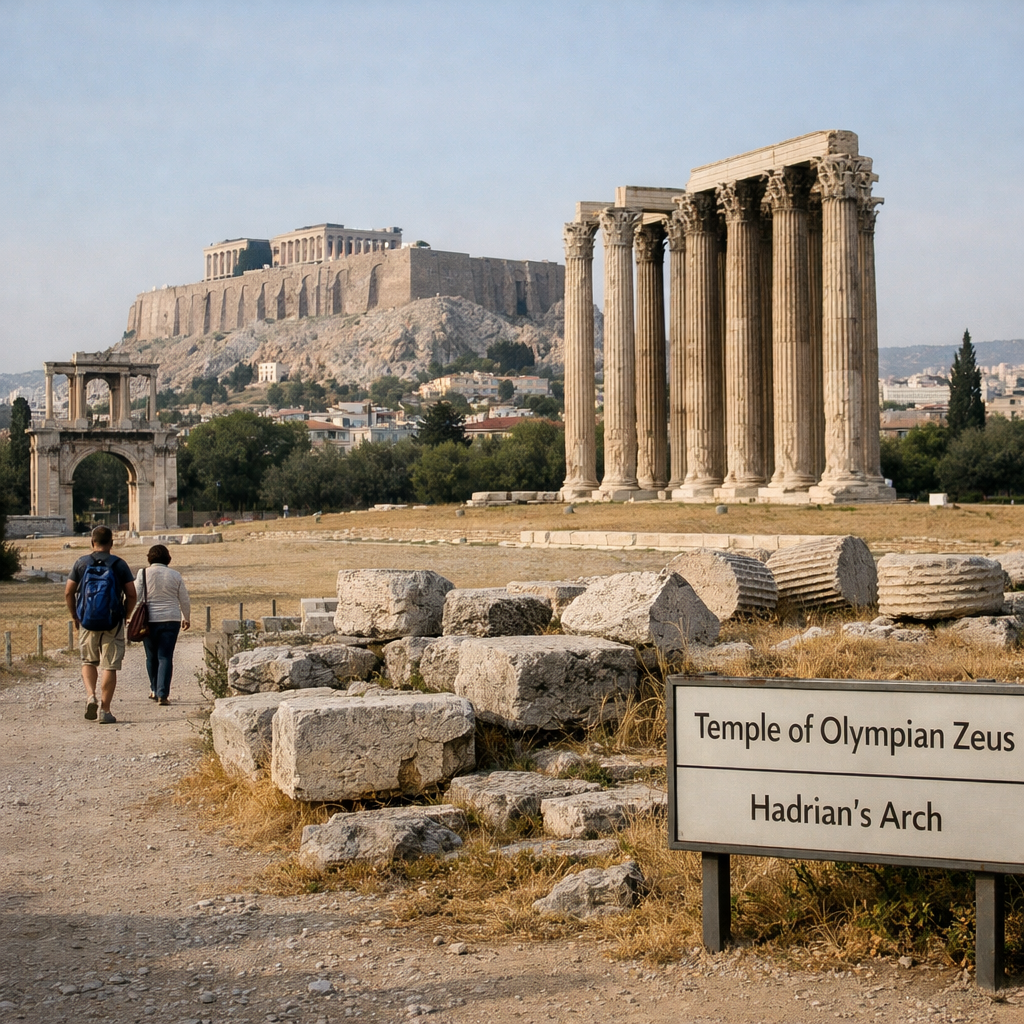
What you see today is an open archaeological area with fallen drums, foundations, scattered stones, and tall Corinthian columns. The columns are the main sight, but the broken remains around them explain the temple’s size better than a single photograph.
Choose the Olympieion when you want ancient Athens without committing to a half-day visit. It fits neatly between breakfast in Plaka and an afternoon visit to the Acropolis Museum.
Temple History: A Project Spanning Centuries
Construction of the Temple of Olympian Zeus began in the 6th century BC, during the period of the Athenian tyrants. The first design was ambitious, but work stopped before the temple reached its final form. Athens had the plan long before it had the political power and money to finish it.
From Greek foundations to Roman completion
The project changed over time. Different rulers and political periods affected its progress, and the temple remained unfinished for centuries. The Roman general and later dictator Sulla is associated with the removal of some temple elements to Rome, showing how unfinished Greek monuments could also become targets of Roman ambition.
The temple was finally completed under the Roman emperor Hadrian in the 2nd century AD, probably around AD 131–132. Hadrian supported major building projects in Athens, and the finished temple became one of the city’s grandest monuments.
Hadrian dedicated the completed temple to Olympian Zeus. A huge statue of Zeus stood inside, while a statue of Hadrian was placed nearby, linking the emperor with the god and with Athens’ classical past.
Why the Corinthian columns matter
The temple used the Corinthian order, recognised by its decorative capitals with carved acanthus leaves. These columns were taller and more ornate than the simpler Doric columns seen at other famous Greek monuments.
The original structure had 104 columns. Today, 15 remain upright, and one additional column lies broken on the ground. Those surviving pieces give you a clear idea of the building’s height, but they do not recreate a complete temple interior.
What happened after antiquity
Like many ancient buildings in Athens, the Olympieion suffered after the Roman period. Earthquakes, stone reuse, weather, and long neglect reduced the temple to foundations and fragments.
The remaining columns are also vulnerable. Do not touch or climb on the ruins, even when a stone looks stable. The site is an active archaeological monument, not a reconstructed attraction with safe access to every piece.
What Will You See Inside the Olympieion?
You will see a wide open area centred on the surviving columns, with views toward the Acropolis and the modern streets of central Athens. The visit feels spacious, but the number of major features is limited, so a planned 30-minute route works better than wandering without a clear focus.
The standing columns
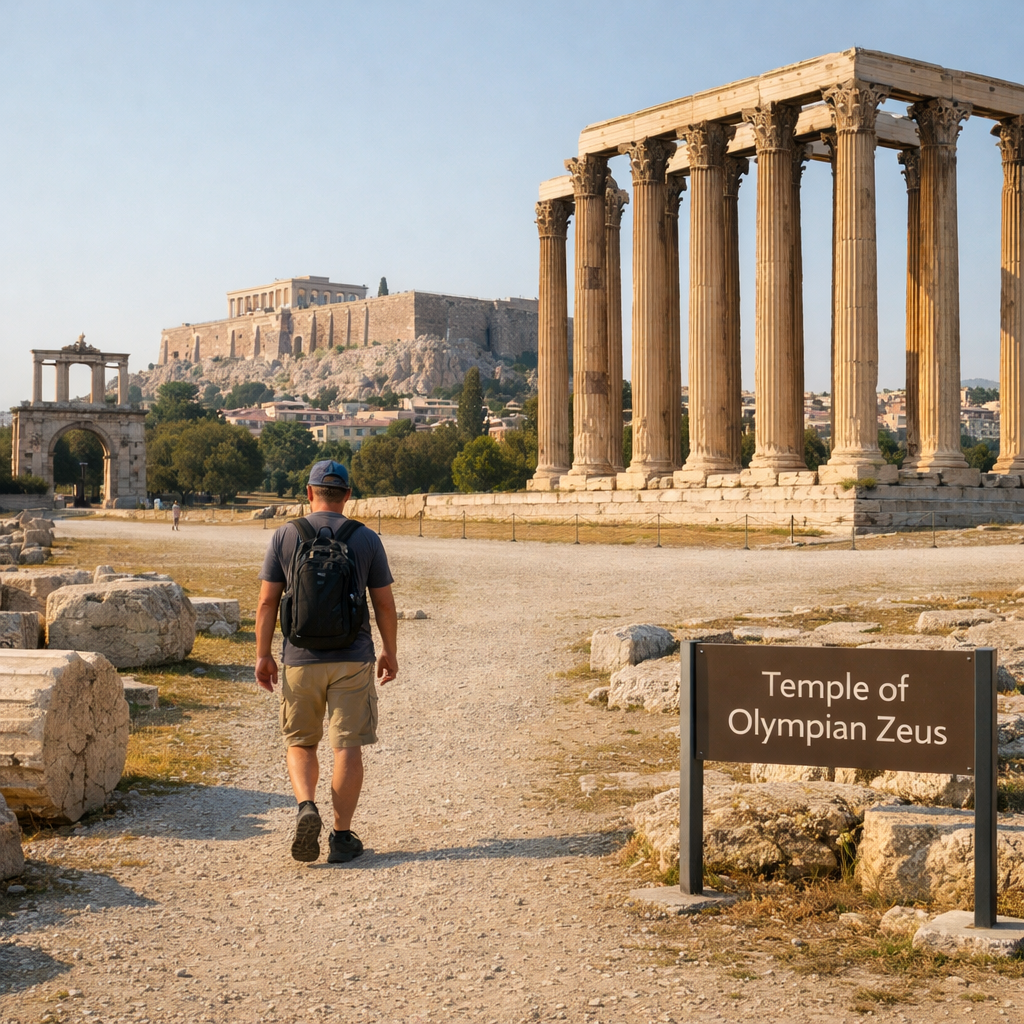
The 15 standing Corinthian columns form the visual centre of the Athens Zeus Temple. Their height and repeated shapes make the site impressive even though most of the building has disappeared.
Look closely at the column drums. Each column was assembled from large stone sections rather than carved as one solid piece. The joints, scale, and weathering are easier to appreciate when you stand near the boundary path instead of viewing everything only from a distance.
One column fell during a storm in the 19th century and now lies in pieces on the ground. It provides a useful comparison: the standing columns show vertical height, while the fallen column shows how the monument was constructed.
The temple foundations and scattered remains
The foundations outline the footprint of the temple, but the site does not offer a complete floor plan at every point. Some areas are easier to understand from the information boards than from the stones themselves.
Take photographs from several sides. The Acropolis appears behind the columns from certain angles, while the National Garden and surrounding streets create a different view from the southern side.
The view toward the Acropolis
The Olympieion is one of the best places to see the Acropolis in context without entering the Acropolis archaeological site. The contrast is useful: the Parthenon sits above the city on a rocky hill, while the Temple of Olympian Zeus once dominated a broad level area below.
Do not expect a quiet rural setting. Traffic, nearby buildings, and city noise are part of the experience. That urban setting is also part of the appeal, because you can move from ancient ruins to Plaka cafés within minutes.
Tickets, Opening Hours, and the Best Time to Visit
Check the official Hellenic Ministry of Culture and Sports ticket information before leaving your hotel. Opening hours and admission rules at Athens archaeological sites change by season, special event, staffing conditions, and public holidays, so an old blog post or saved social media image is not reliable.
Admission prices also change. The Athens archaeological sites ticket may include several locations during a defined period, but the exact sites, validity rules, and seasonal options must be confirmed for your travel dates. Do not assume that a ticket covering the Acropolis automatically includes every nearby monument under every ticket scheme.
A practical visit window
For a standalone stop, allow 30 to 60 minutes. Arrive early in the morning during July or August, when exposed stone and open ground become uncomfortable later in the day.
Spring and autumn are easier for walking. April, May, October, and November usually offer more comfortable conditions than the hottest summer afternoons, though you still need to check the forecast and official access information.
The site has limited shade. Carry water, wear shoes with a firm sole, and bring a hat if you plan to combine the Olympieion with Plaka or the Acropolis on foot.
How to avoid outdated information
Before your visit, check four details on the official source:
The opening time for your date.
The last entry time.
The current single-site admission price.
Whether a combined archaeological sites ticket is available.
The last-entry time matters most if you are arriving after lunch. Archaeological sites may close earlier than expected outside the main summer season, and entry can stop before the gates fully close.
Is the ticket worth it?
The answer depends on your route. If you are visiting only the Olympieion and watching your spending, compare the single-site price with the cost of a combined ticket you will actually use. A combined ticket makes sense when your plan includes several covered sites, not when you buy it only because it sounds convenient.
If you already plan to visit the Acropolis, Ancient Agora, Roman Agora, or Kerameikos, review the current combined options before paying separately. Ticket rules can change, so make the decision from the official list for your travel date.
How to Reach the Athens Zeus Temple
The Athens Zeus Temple is easy to reach from central Athens. It is within walking distance of Syntagma Square, Plaka, the Acropolis, and the Acropolis Museum, so most visitors do not need a taxi for this stop.
The nearest metro access is commonly associated with Acropoli and Syntagma stations, while tram services run through central Athens near the site. Routes and station exits can change because of works or events, so check OASA information or a live map on the day.
Walking from central Athens
From Syntagma Square, expect a practical city walk of roughly 15 minutes, depending on your route and pace. From Plaka, the walk is shorter and works well as part of a morning sightseeing loop.
A strong route begins in Syntagma, continues through the National Garden, reaches Hadrian’s Arch, and then enters the Olympieion if the gate is open. After the visit, continue toward the Acropolis Museum or Plaka.
Using public transportation
Use an ATH.ENA Ticket or ATH.ENA Card according to the transport option that fits your stay. Athens public transport uses the metro, buses, trolleybuses, and tram, but ticket validity and fare products should be checked before travel.
The metro is usually the fastest choice from areas such as Omonia, Monastiraki, or the northern suburbs. The tram is useful from parts of the southern coastal route, although it is slower than the metro for some central journeys.
Do not plan around a single bus number without checking live information. Athens traffic, demonstrations, road closures, and seasonal changes can alter surface routes, especially around Syntagma and the historic centre.
When a taxi makes sense
A taxi is useful with luggage, children, mobility concerns, or a hotel far from the metro. It is not my first choice for a normal sightseeing visit because traffic around central Athens can make a short road journey unpredictable.
If you use a taxi, confirm the destination as “Temple of Olympian Zeus” or “Olympieion,” not simply “the Acropolis.” The names describe different monuments, and a rushed instruction can send you to the wrong entrance or hill.
For route planning across flights, hotels, transfers, and Athens activities, a comparison guide such as mygreekpath.com can make the wider holiday plan easier to organise, while official transport and monument pages should provide the final operational details.
The Best Walking Combinations Around the Olympieion
The Olympieion works best as part of a central Athens walking route. Its location gives you several strong combinations, and each one takes a different amount of time and energy.
Start with the shortest option if you have a cruise stop, a late arrival, or a few hours between hotel plans.
Option 1: Hadrian’s Arch and the temple
Hadrian’s Arch stands beside the main road near the Olympieion and is easy to miss if you focus only on the fenced archaeological grounds. Stop at the arch first, take photographs from both sides, and then continue to the temple entrance.
This combination works in about 45 to 75 minutes, depending on your time inside the site. The arch is outside the paid archaeological area, so you can see it even if the Olympieion is closed.
The arch dates from the Roman period and links the old city with Hadrian’s Athens. It provides context before you enter the larger temple grounds.
Option 2: Syntagma, the National Garden, and Plaka
Walk from Syntagma Square through the National Garden, then continue to Hadrian’s Arch and the Olympieion. Afterward, head into Plaka for lunch or coffee.
This route suits a first day in Athens because it combines a public square, greenery, Roman monuments, and traditional central streets. Allow roughly two to three hours if you stop for food and photographs.
The route has plenty of distractions, so watch the time if you have a timed Acropolis entry. The Olympieion is flexible; a timed attraction should control your schedule.
Option 3: Acropolis Museum and the Olympieion
The Acropolis Museum is within walking distance of the temple. Visit the museum first if you want historical context, then walk toward the Olympieion through the streets around the Acropolis.
This is a strong pairing when you want indoor time during the hottest part of the day. The museum gives you detailed sculpture and architectural information, while the Olympieion shows monumental ruins in the open air.
Allow at least half a day for this combination if you plan to visit the museum properly. Do not squeeze both into a rushed two-hour gap.
Option 4: Acropolis, Roman Agora, and Olympieion
This is the longest route. Begin with the Acropolis early, continue through the Roman Agora or Ancient Agora according to your ticket, and finish at the Olympieion.
Choose this plan only if you are comfortable walking several kilometres in warm weather. The Acropolis includes steep and uneven areas, while the Olympieion has exposed paths and little shade.
The reward is a clear progression from classical Athens to Roman Athens. The drawback is fatigue, especially in August, when the final stop may receive less attention than it deserves.
Common Mistakes That Reduce the Visit
The first mistake is calling the Olympieion the Acropolis. They are separate sites with different entrances, histories, and ticket arrangements. The Acropolis includes the Parthenon and other monuments on the hill; the Temple of Olympian Zeus stands below it in a different archaeological area.
The second mistake is expecting a complete temple. You will not walk through intact rooms or see a standing roof. The experience comes from the scale of the columns, the foundations, the fallen stone, and the view back toward the Acropolis.
Mistake: trusting old practical details
Opening hours, admission prices, and combined ticket rules are not permanent. A guide written before 2020 may still describe a ticket or schedule that no longer exists.
Check the official information shortly before your visit. If you are travelling on a Sunday, public holiday, or during winter, give this check extra attention.
Mistake: ignoring the weather
A compact site can still feel demanding under direct sun. A 40-minute visit at midday in August may be harder than a longer visit at 08:30.
Wear walking shoes and carry water from the start. Do not rely on finding shade beside the columns, because the open grounds have limited protection.
Mistake: skipping Hadrian’s Arch
Hadrian’s Arch is directly outside the archaeological grounds and takes only a few minutes to see. Many visitors pass it while looking for the entrance to the temple.
Put the arch into your route before entering. It adds Roman context at no extra site time, and its position makes the change from ancient Athens to Hadrian’s city easier to understand.
Mistake: overplanning the stop
Do not reserve an entire day for the Olympieion alone. The site is valuable, but its compact size makes it better as one part of a central Athens plan.
Set aside 30 to 60 minutes, then spend your remaining time at the Acropolis Museum, Plaka, the National Garden, or another site covered by your ticket.
Is the Olympieion Worth Visiting?
Yes, the Olympieion is worth visiting if you want a short archaeological stop with large-scale Roman history and a direct view of the Acropolis. It is especially worthwhile when your route already includes Hadrian’s Arch, Plaka, Syntagma, or the Acropolis Museum.
It is not the best choice for visitors seeking a complete monument with rooms, sculptures, and a long sequence of buildings. The Parthenon and Acropolis Museum provide a fuller experience, while the Olympieion gives you one powerful architectural idea: the size of a temple that mostly disappeared.
Choose the Olympieion when you have limited time
With two hours before a meal or appointment, the temple fits easily. You can walk from Syntagma, see Hadrian’s Arch, spend 30 minutes inside, and continue toward Plaka.
This is also a good choice on a second Athens day, when you have already visited the Acropolis and want a less demanding ancient site.
Choose another site when you want more detail
If you want inscriptions, sculpture, and a longer archaeological route, choose the Acropolis, Ancient Agora, or Acropolis Museum instead. These sites offer more objects and interpretation.
The Olympieion is mainly an architectural stop. Its strongest moments come from standing near the columns, comparing their scale with nearby people and buildings, and looking toward the Acropolis.
A simple decision rule
Choose the Olympieion if you can place it beside another central Athens stop. Skip it if reaching the area requires a long detour and you have only one day for the city.
The main drawback is clear: much of the temple is gone. The main benefit is equally clear: you can experience a major monument in under an hour and continue walking through Athens without losing half your day.
Conclusion
Visit the Olympieion as a focused stop, not a full-day attraction. Check the official hours and ticket rules, arrive early in hot weather, see Hadrian’s Arch outside the entrance, and pair the temple with Plaka, the National Garden, or the Acropolis Museum. If your schedule has one free hour in central Athens, the Athens Zeus Temple is a smart addition.
Frequently Asked Questions
Is the Athens Zeus Temple the same as the Acropolis?
No. The Athens Zeus Temple is the Temple of Olympian Zeus, located below the Acropolis near Hadrian’s Arch. The Acropolis is the hill complex that includes the Parthenon, so they require separate route planning and may have separate ticket rules.
How long should I spend at the Olympieion?
Plan 30 to 60 minutes for the archaeological site, plus a few minutes for Hadrian’s Arch outside the entrance. Add more time if you want a slow photography stop or a break near the National Garden.
Can I see Hadrian’s Arch without buying a ticket?
Yes. Hadrian’s Arch stands outside the Olympieion archaeological grounds and is visible from the surrounding street. You can photograph it even when the temple site is closed, although traffic and pedestrian movement may affect your viewing position.
Are there bathrooms and much shade at the site?
Do not plan on extensive shade inside the archaeological grounds. Facilities and access conditions can change, so use a nearby café or public facility before entering, especially during a summer walk around central Athens.