15 kilometres separate Athens International Airport from Piraeus Port Greece, but the trip can take far longer when traffic builds on the Athens–Piraeus road. That distance matters when your ferry leaves at 07:00 and you still need to collect tickets, find the correct gate, and load luggage.
Piraeus is Athens’ main ferry port, not the airport and not one single departure point. Use the metro when your luggage is manageable, choose a taxi or private transfer for tight schedules or groups, and check your ferry’s exact gate before leaving Athens.
Key Takeaways
Piraeus has multiple ferry gates, not one universal terminal
Metro Line 1 reaches the port from central Athens
Check the island’s arrival port before booking
Arrive 60–90 minutes early for most ferry departures
Airport transfers need extra time during traffic
Compare metro, taxi, and private transfer costs
How Piraeus Port Is Organized
Piraeus Port is divided into several gates around a large waterfront area. Your ferry’s destination and operator determine the departure gate, so the port name alone is not enough for planning. A ferry to Mykonos, a high-speed service to Aegina, and a vehicle ferry to Crete may leave from different parts of the port.
The main gate areas
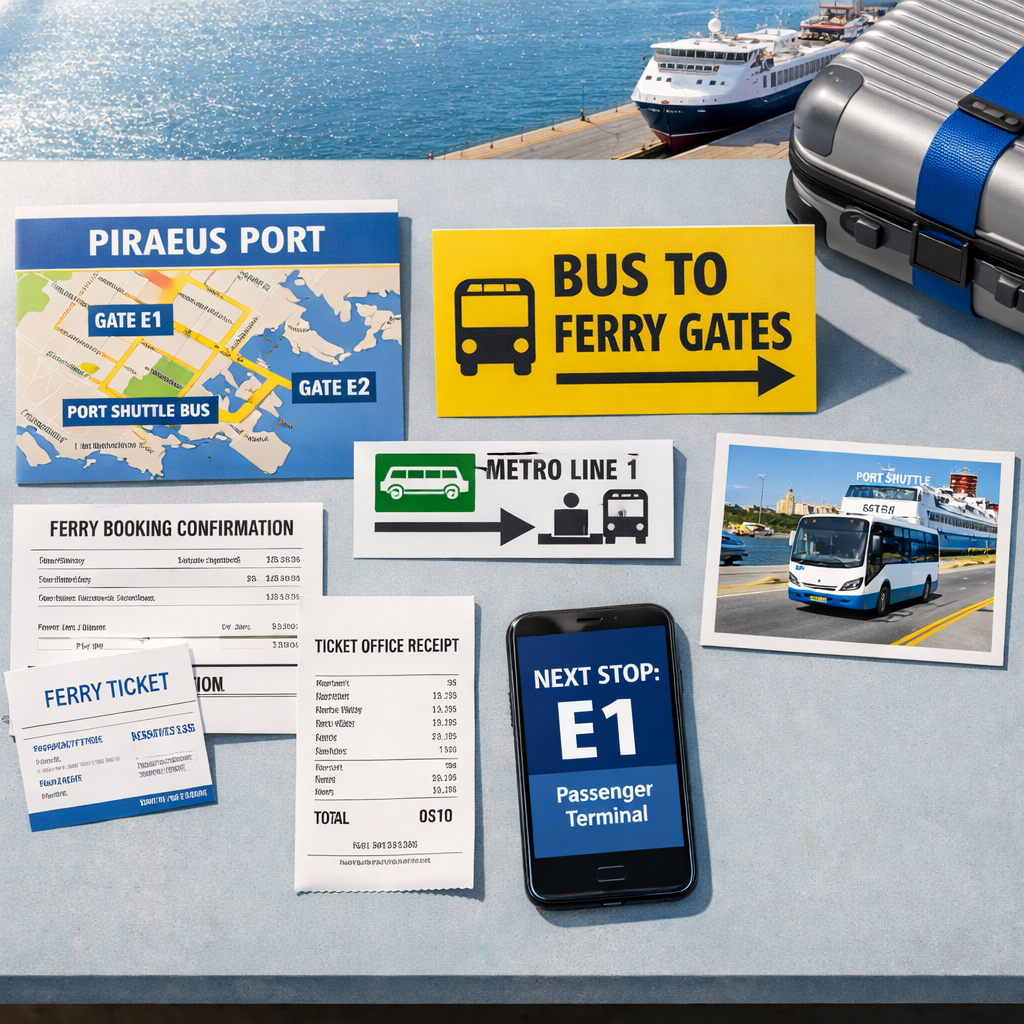
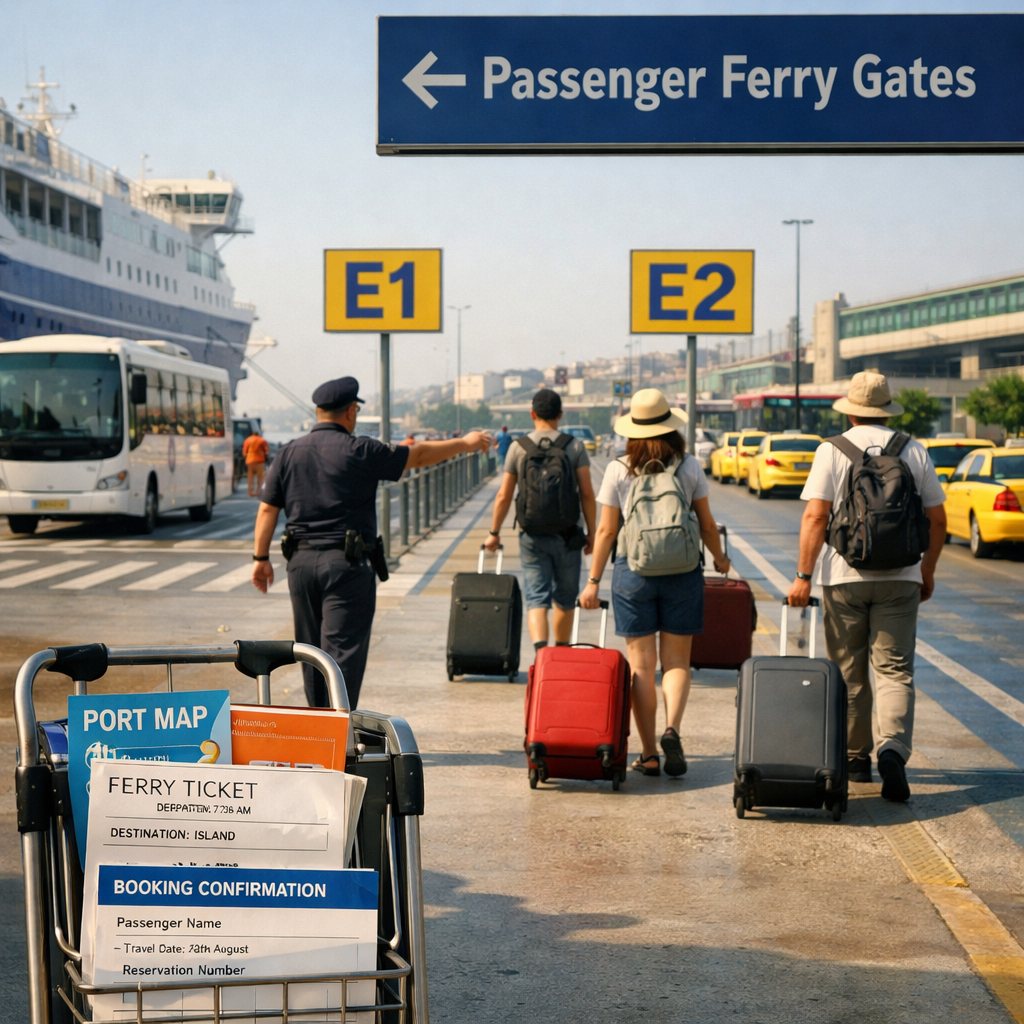
The port uses numbered gates, and the numbers printed on your ticket or booking confirmation matter. E1 and E2 are commonly associated with longer routes toward Crete and the Dodecanese, while other gates serve the Cyclades, Argosaronic islands, or domestic routes. Gate assignments can change, so check the latest ticket information before departure.
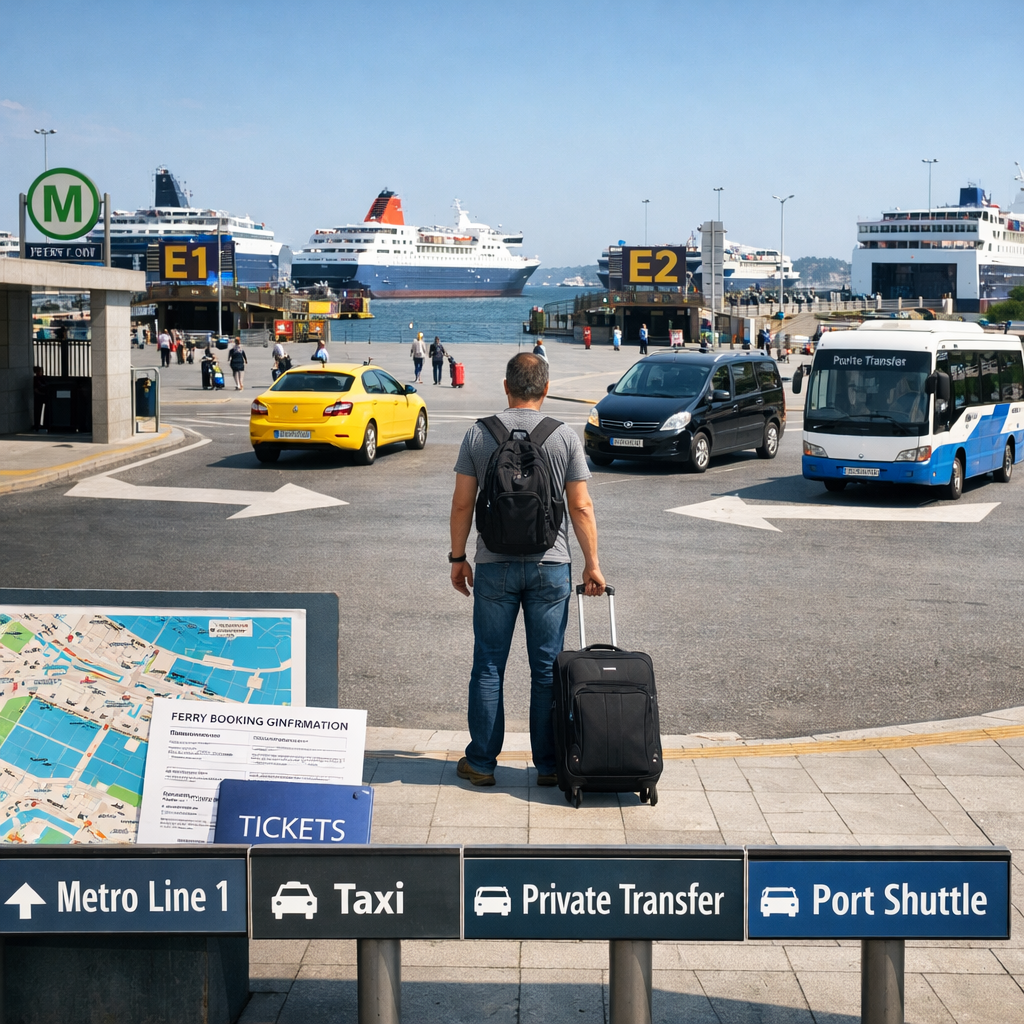
The Piraeus Metro Station is close to the port’s central passenger area, but it is not beside every gate. Walking from the station to a distant gate with suitcases can take much longer than expected. Some gates are better reached by taxi or the free port shuttle when one is operating.
Do not follow the first ferry sign you see.
Piraeus is a working port with container areas, vehicle access roads, warehouses, ticket offices, and passenger zones. A route that looks short on a map may involve a long walk around restricted areas. Ask port staff or your ferry company for directions if the gate on your ticket is unclear.
Match the gate to your ferry
Your booking confirmation should show the ferry company, departure time, vessel, destination, and gate or boarding area. Companies such as Blue Star Ferries, Seajets, Hellenic Seaways, and Minoan Lines operate different services from Piraeus, and their boarding points are not always identical.
If your ticket only says “Piraeus,” search the ferry company’s current departure information or call its local office. This is especially important for early sailings, when fewer staff and fewer buses are available. A small mistake can mean crossing the port on foot while boarding is already underway.
Piraeus also has passenger ticket agencies near the port. They can help with printed tickets, changes, and directions, but do not assume every agency handles every operator. A digital ticket is often accepted, yet some bookings still require collection of a paper ticket or vehicle document.
Allow time for the port itself
For a domestic ferry without a car, arriving 60 minutes before departure is a sound minimum. For a busy summer sailing, a vehicle booking, a large group, or an unfamiliar gate, arrive 90 minutes early. Follow the longer window when your ferry departs before 08:00.
The scheduled departure time is not your arrival target. It is the moment the vessel is expected to leave, and boarding may close earlier. A 07:00 ferry means you should plan to be at the gate around 06:00, not arrive at the port at 07:00.
Ferry Routes and Island Destinations
Piraeus connects Athens with the Cyclades, the Saronic Gulf islands, Crete, the Dodecanese, and several northeastern Aegean destinations. The correct ferry depends on your island, travel date, vehicle needs, and tolerance for a longer crossing. A direct sailing is usually easier for first-time island travelers than a connection through another port.
Cyclades routes
Popular Cyclades destinations include Mykonos, Santorini, Paros, Naxos, Milos, Syros, and Tinos. High-speed ferries often reduce sailing time but cost more and may provide a less comfortable ride in rough weather. Conventional ferries are slower and usually offer more open deck space, larger vehicle areas, and different seating options.
A ferry to Santorini may take several hours, depending on the vessel and route pattern. A high-speed service can be substantially quicker than a conventional ship, but the fare difference can matter for a family of four. Compare the full price, including seats and luggage rules, before choosing only by duration.
For Paros and Naxos, look closely at the arrival time rather than focusing only on the departure. Arriving at 10:00 gives you more usable holiday time than arriving after sunset, even if both sailings leave Piraeus at similar times on different days.
Saronic Gulf islands
Aegina, Agistri, Poros, Hydra, and Spetses are the main island choices in the Saronic Gulf. These routes are useful for short breaks because they are closer to Athens than most Cyclades destinations. Aegina is often practical for a day trip, while Hydra and Spetses suit travelers seeking a car-free island stay.
Fast passenger services and conventional ferries operate on these routes. Some boats carry only passengers, while others carry vehicles. Check this detail before arriving with a rental car, because a passenger-only vessel cannot solve a vehicle transfer problem at the port.
The island’s arrival port also affects your hotel transfer. Hydra Town, Poros Town, Aegina Town, and Agistri’s ports are not interchangeable. A hotel on the other side of an island may require a taxi, local bus, or water taxi after you disembark.
Crete and longer crossings
Piraeus has overnight and daytime ferry connections to Crete, including Heraklion and Chania services depending on the operator and season. Overnight travel can save a hotel night, but a cabin costs more than a deck or standard seat. For families, a cabin can also make an early arrival less tiring.
The arrival port matters immediately in Crete. Heraklion and Chania are different cities with separate airports, bus networks, and hotel areas. Booking the cheapest ticket without checking the port can add hours of ground travel after arrival.
Read the route in full before paying. A sailing listed for “Crete” is incomplete information; you need the exact port, arrival time, vessel, and any intermediate stops.
Getting to Piraeus from Athens
For most travelers staying in central Athens, Metro Line 1 is the best-value route to Piraeus. It connects areas such as Omonia and Monastiraki with Piraeus Metro Station, and it avoids road traffic. The drawback is carrying luggage through stations and walking from the station to your gate.
Metro Line 1
From central Athens, take Line 1, the green line, toward Piraeus. The station is close to the port’s central passenger zone, but you still need to walk to the correct gate. This option works especially well for one or two people with rolling bags and a ferry departure later in the morning.
The Athens metro does not deliver you directly beside every ferry. Check the gate before selecting it as your only plan. A departure from a distant gate may require a taxi for the final section, especially if you have children, heavy bags, or a mobility limitation.
Buy the correct Athens public transport ticket and validate it where required. Keep your ferry booking open on your phone, but do not rely on a weak mobile signal at the port. Save the gate details and ferry name as screenshots before leaving your hotel.
Bus connections
Athens buses and trolleybuses reach Piraeus from several districts, while the express airport bus X96 links Athens International Airport with Piraeus. The airport bus is useful outside metro operating hours, but it is exposed to traffic and may take longer than a rail connection.
The X96 is a practical choice for travelers landing late or catching an overnight ferry. Check the current route, ticket rules, and operating frequency on the day you travel because public transport timetables change. During strikes, the airport bus may be one of the few available public options, but disruption is still possible.
Do not confuse the airport with the port when checking your transfer. Athens International Airport is east of the city, while Piraeus is southwest on the coast. They are connected by transport, but they are not adjacent terminals.
Taxi and private transfer
A taxi is the fastest door-to-door choice when traffic is light, your gate is distant, or four passengers are sharing the fare. It becomes less attractive when one person can use the metro with a small bag and the ferry leaves outside the busiest road hours.
Private transfers work well for families, large luggage, late arrivals, and ferry departures before public transport is convenient. The driver should receive your ferry company, gate number, vessel name, and departure time, not only “Piraeus Port.” That information prevents a drop-off at the wrong side of the port.
My Greek Path compares transport and booking options alongside ferry planning, which is useful when the cheapest transfer takes too long for your sailing. Compare based on luggage, group size, and gate location rather than choosing a taxi automatically.
Airport Transfers and Timing
If you land at Athens International Airport on the same day as your ferry, build the plan around risk, not the shortest possible journey. Allow time for baggage collection, passport checks when applicable, delays on the runway, and the road or rail trip to Piraeus.
Same-day airport-to-ferry planning
A same-day connection is most comfortable when you land at least four hours before the ferry’s scheduled departure. This is a planning rule, not a guarantee. A delayed flight, a crowded baggage belt, or summer traffic can consume that margin quickly.
For example, a 09:00 airport arrival followed by a 14:00 ferry gives you five hours between scheduled times. That looks workable, but you still need to leave the airport, travel to Piraeus, locate the gate, and account for boarding. A 12:00 arrival for the same ferry is a poor plan.
If missing the ferry would damage your holiday, sleep near Piraeus or Athens the previous night. This costs an extra hotel night, but it removes the most expensive type of stress: trying to recover an island booking after a missed sailing.
Choosing the right transfer
The metro from the airport reaches central Athens and then connects toward Piraeus, but the full journey involves more time and luggage handling than a direct car. It is usually the right choice for budget travelers with light luggage and plenty of time.
A taxi or private transfer is better for three or four travelers with suitcases, an early sailing, or a gate far from Piraeus Metro Station. The fastest route is not always the cheapest, and the cheapest route is not always the safest when your ferry cannot wait.
Ask for the total price before the trip. Confirm whether tolls, airport pickup, luggage, nighttime service, and waiting time are included. Keep the written booking details because the port has several access roads and pickup points.
Traffic, strikes, and summer pressure
Travel times between the airport and Piraeus are not fixed. Traffic on Attiki Odos, Kifisias Avenue, or roads near the port can change the journey sharply, especially on Friday afternoons and in July or August.
Public transport strikes can affect the metro, suburban rail, or buses. Ferry workers may also announce separate industrial action. Check the ferry operator, Athens transport updates, and airport information on the day before travel.
If a strike affects your route, contact the ferry company before buying a last-minute replacement ticket. Do not assume a delayed public transport service will be accepted as a reason to hold the vessel.
Tickets, Boarding, and Luggage
Ferry tickets are tied to a specific route and date, and many popular summer sailings sell out early. Reserve as soon as your island dates are firm, especially for Santorini, Mykonos, Crete, or any crossing with a vehicle.
Compare the complete fare
A basic passenger fare may not include a reserved seat, cabin, meal, vehicle, or flexible change conditions. Compare the final booking total, not the first price shown in a search result. A faster ferry with an assigned indoor seat may cost more but suit a traveler who dislikes long crossings.
Search by exact arrival port. “Santorini” usually means Athinios, while “Crete” could mean Heraklion or Chania. For Saronic Gulf trips, confirm whether the service arrives at Aegina Town, Hydra, Poros, or another local port.
Keep the operator’s booking number available. If you need to change a ticket, the agency or ferry company may require identification and the original booking details.
A reliable departure sequence
Use this sequence for a morning ferry:
Check the gate, vessel, and boarding rules the evening before.
Set your arrival target 60–90 minutes before departure.
Carry your ticket, identification, and accommodation details offline.
Reach the port and confirm the gate with staff or clear signage.
Board early if you have a vehicle, cabin, or large luggage.
Keep your ticket until disembarkation and final port checks.
Vehicle passengers usually need more time than foot passengers. Follow the operator’s vehicle check-in instructions, and do not leave a rental car return until you understand how you will reach the port gate.
Boarding reality
Ferries may begin loading well before departure, particularly when trucks and cars must enter the vehicle deck. A passenger who arrives at the gate at the advertised departure time may find that boarding has already closed.
Watch the screens and listen for announcements. Gate information can change, and the vessel displayed beside your destination may use a shortened route name. Ask staff when two ships leave for similar islands close together.
A ticket is not a guarantee that the ship will wait. Port operations depend on loading, weather, and traffic inside the harbor.
Bags and port facilities
Large luggage is usually placed in a designated storage area or vehicle deck, while small bags stay with passengers. Keep medication, passports, chargers, valuables, and one change of clothes in a small carry-on. Do not put these items into a bag you will not access during the crossing.
Piraeus has cafes, shops, ticket offices, toilets, waiting areas, and ATMs around the passenger zones, but services vary by gate. Buy water and snacks before walking to a distant departure area, especially for an early sailing.
If you need accessibility assistance, contact the ferry operator before travel. Explain whether you use a wheelchair, need help with stairs, or require priority boarding. The port is large, and advance notice gives staff time to coordinate help.
A Practical Port Plan for First-Time Travelers
A good Piraeus plan begins with the ferry ticket, not the taxi booking. Write down the operator, vessel, departure time, arrival port, gate, and hotel address on the island before leaving Athens.
The evening before
Check the ferry company’s website or booking message after 18:00 if your sailing is early the next morning. Confirm weather notices, gate details, cancellations, and any timetable update. Save screenshots because port reception can be inconsistent.
Pack documents separately from your main luggage. You need identification, ferry tickets, transfer details, hotel confirmation, and any vehicle paperwork in one accessible place.
Set two alarms. Leave extra time for finding the correct road into the port, because a driver may need to approach a specific gate rather than the central station.
The morning of departure
Eat before reaching the gate if your ferry leaves early. Some cafes may not be open at 05:30, and queues form quickly around popular departures. Carry a refillable bottle and a small snack.
If you use the metro, check the first suitable train rather than assuming the system runs all night. If you use a taxi, order it early and verify the vehicle and pickup location. At the port, show the driver the exact gate.
For a 07:00 departure, I would target the gate by 06:00 and leave central Athens earlier according to the transport method. From the airport, I would use a wider buffer or travel the previous evening.
When plans change
Ferry schedules can change because of strong winds, mechanical issues, strikes, or port restrictions. High-speed services are often more sensitive to rough seas than larger conventional ferries, although the operator makes the final decision.
If your sailing is canceled, contact the operator or ticket agency before arranging a hotel or new transport. Ask about transfer rights, refund conditions, and the next available sailing. Keep receipts if staff direct you to pay for additional transport.
If you miss the ferry because of a late taxi or traffic, the operator usually treats that differently from a company cancellation. Travel insurance terms vary, so check them before your holiday begins.
Your arrival on the island
The ferry’s arrival port determines what happens next. Check whether your hotel offers pickup, whether a local bus meets the sailing, and whether taxis wait at the port. This matters most on islands with several villages and limited evening transport.
On Santorini, for example, Athinios is a busy port with steep roads and heavy arrival crowds. On Hydra, vehicles are not used in the same way as on larger islands. On Aegina, the town port may be simple to reach, but a hotel outside town still needs a local transfer.
Book a transfer when your arrival is late, your party has bulky luggage, or your accommodation is far from the port. Otherwise, identify the bus stop or taxi rank before the ship docks, while you still have a signal and time to think.
Conclusion
Choose the metro from central Athens when you have light luggage and a comfortable time margin. Choose a taxi or private transfer when your gate is distant, your group is larger, or the ferry leaves early. Check the exact gate and arrival port tonight, then plan to stand there 60–90 minutes before departure.
Frequently Asked Questions
Is Piraeus Port the same as Athens International Airport?
No. Athens International Airport is about 15 kilometres from Piraeus, on the opposite side of the Athens urban area. You must travel between them by metro, bus, taxi, or private transfer, and traffic can make road travel unpredictable.
How early should I arrive at Piraeus for a ferry?
Arrive 60 minutes before departure for a normal foot-passenger trip and 90 minutes early for summer travel, vehicles, large groups, or an unfamiliar gate. For a 07:00 sailing, reaching the gate by 06:00 is a sensible target.
Can I walk from Piraeus Metro Station to my ferry?
You can walk from the station to some central gates, but not every departure gate is nearby. Check the gate number first; a distant gate may require a taxi, port shuttle, or much more time with luggage.
What happens if bad weather cancels my ferry?
Contact the ferry operator or ticket agency for rebooking or refund instructions. Do not buy a replacement ticket immediately unless you confirm the original ticket’s status, because cancellation rules differ between operator, route, and ticket type.