Greece and Greek Islands: Regions, Maps and Travel Tips
A single ferry crossing can take 30 minutes or more than 8 hours, so the most famous island is not always the best choice for your trip. Greece and Greek islands work better when you plan around airports, ferry ports, and transfer time before choosing beaches or hotels.
The mainland, Crete, and each island group offer different climates, transport patterns, and travel speeds. A map helps, but a practical route plan tells you whether your vacation will feel relaxed or like a series of departures.
Key Takeaways
Athens is the main mainland and ferry gateway
Crete works well for longer, self-contained trips
Cyclades routes are convenient but seasonal
Ferry distances often exceed map expectations
Choose two or three bases for a week
Santorini and Mykonos are not typical Greek islands
How Greece Is Organized for Travelers
Greece has a mainland, a large island of Crete, and several island groups spread across the Aegean and Ionian seas. For trip planning, these regions matter more than administrative boundaries because each one has different airports, ferry networks, road conditions, and weather patterns.
The mainland includes Athens, the Peloponnese, Central Greece, Thessaly, Epirus, and northern regions such as Macedonia and Thrace. Athens is usually the easiest international arrival point for US travelers, while Thessaloniki is useful for northern Greece and nearby destinations.
Crete is Greece’s largest island and sits south of the mainland. Its airports in Heraklion and Chania, long-distance bus routes, archaeological sites, and mountain villages make it a complete destination rather than a short island stop.
“The wine-dark sea.” — Homer, The Odyssey
That famous phrase reflects Greece’s geography: water connects many places, but it also creates travel boundaries. A destination that looks close on a Greek travel map may require a port transfer, a waiting period, and several hours on a vessel.
The Aegean island groups
The Cyclades include Santorini, Mykonos, Naxos, Paros, Milos, and smaller islands. They are known for dry hills, whitewashed settlements, strong summer winds, and ferry links centered on Piraeus and sometimes Rafina.
The Dodecanese lie southeast of the mainland near Turkey. Rhodes and Kos have international airports and broad hotel markets, while islands such as Symi, Patmos, and Karpathos require more detailed transport planning.
Islands west and north of Greece
The Ionian Islands include Corfu, Kefalonia, Zakynthos, Lefkada, Ithaca, and smaller islands. They generally have greener scenery than the Cyclades and are often reached by plane, road-and-ferry combinations, or regional boats.
The Sporades, including Skiathos, Skopelos, and Alonissos, sit off the eastern mainland. The North Aegean Islands, including Lesbos, Chios, Samos, and Ikaria, are farther from the main Cycladic routes and often reward travelers who want fewer international-tourism pressures.
Which Region Fits Your Trip?
For a first Greek vacation, choose the region according to your available time and arrival airport. With five nights, stay on the mainland, Crete, or one island group. With seven to ten nights, combine Athens with one nearby island or choose two islands linked by a direct ferry.
A traveler landing in Athens can reach the Cyclades through Piraeus or Rafina. A traveler flying directly to Rhodes, Corfu, or Heraklion can avoid an Athens transfer and spend more time at the destination.
The Peloponnese suits travelers who want ancient sites, beaches, and driving without depending on island ferries. Nafplio, Epidaurus, Olympia, and the Mani region can form a road trip, although driving times are longer on mountain roads than they appear on a basic map.
Northern Greece is a separate travel idea. Thessaloniki, Meteora, Halkidiki, and Mount Olympus cannot be added casually to a short Athens-and-islands itinerary. A traveler with six days should usually choose either the north or the Aegean, not both.
When Crete makes more sense
Crete is a strong choice for eight nights or more because you can base yourself in one area and still find beaches, villages, museums, and food traditions nearby. Chania and Heraklion are roughly different travel bases, not interchangeable hotel locations.
Crete also reduces ferry dependence. You can rent a car, use intercity buses, or arrange local transfers, then reserve one ferry only if you want to continue to another island.
How Ferry Routes and Airports Actually Work
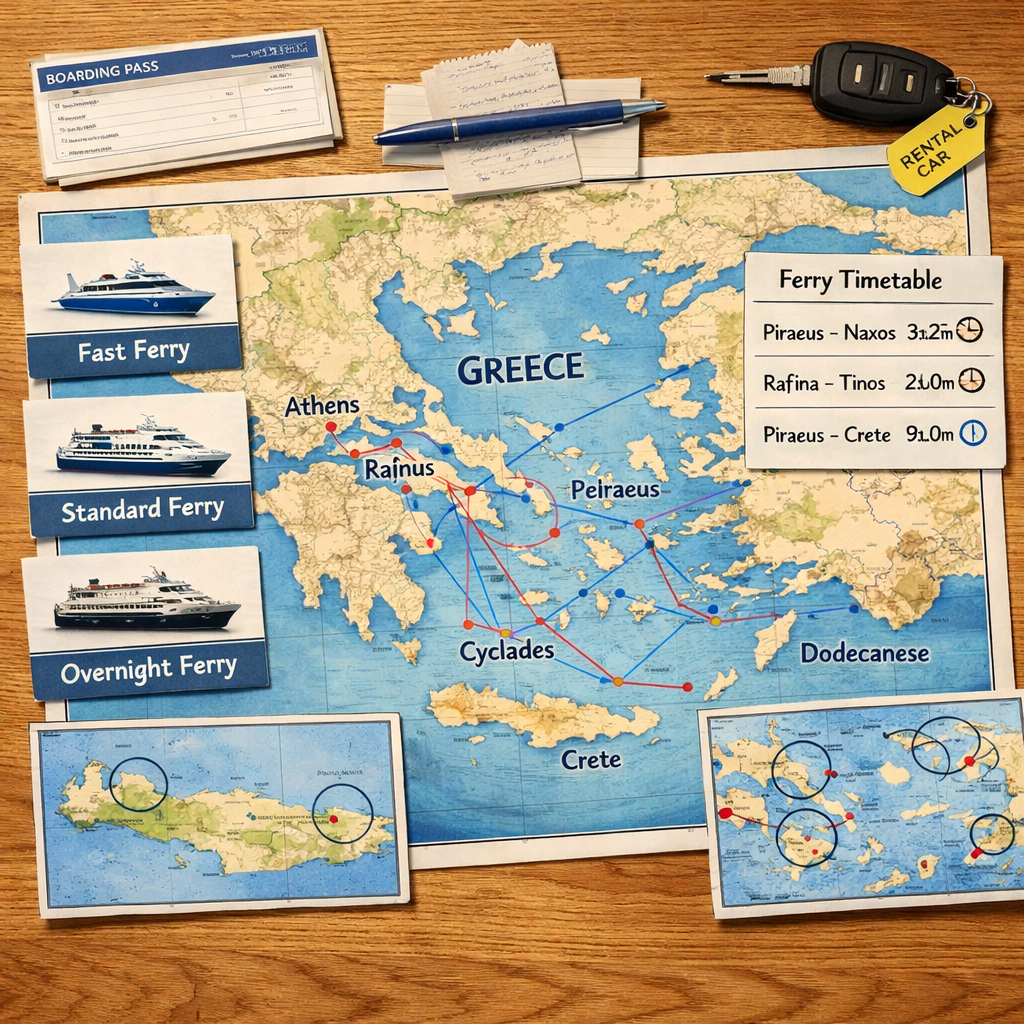
Greek travel logistics usually follow a hub system. Athens connects to major ferry ports and domestic flights, while larger islands connect smaller nearby islands. Routes change by season, vessel type, weather, and operating company, so a map alone cannot confirm a usable itinerary.
Piraeus is the principal port for many Cyclades and Dodecanese services. Rafina, east of Athens, is often more convenient for some Cycladic departures, particularly when combined with Athens International Airport, but the best port depends on your sailing and hotel location.
Build the route around transport hubs
Start with the international flight, then check the domestic flight or ferry, and only afterward choose the hotel. This order prevents a common mistake: booking a prepaid room on an island that requires an awkward overnight connection.
A route such as Athens–Naxos–Paros–Athens is easier to manage than Athens–Milos–Amorgos–Rhodes–Athens. The second plan crosses different ferry corridors and may require returning through a major hub.
A reliable booking sequence
Confirm your US-to-Greece arrival and departure airports.
Check seasonal ferry routes for your travel dates.
Compare arrival times with hotel check-in hours.
Leave a buffer before any separate flight.
Book the route, then choose refundable lodging where possible.
Ferries often arrive at busy ports with limited shade, taxis, and luggage storage. In July or August, allow extra time for boarding and port traffic, especially around Piraeus.
Ferry categories and travel time
High-speed catamarans often shorten the crossing but cost more and may feel rougher in strong wind. Conventional ferries take longer but usually offer more space, vehicle transport, and a steadier ride.
A short crossing between nearby islands may take under an hour, while a route from Athens toward the Dodecanese can take many hours. Check the scheduled duration, not just the straight-line distance.
The practical rule is simple: treat a ferry day as a travel day. A 10:00 a.m. sailing may require an early hotel departure, port arrival, boarding time, and local transport after docking.
How to Read Greek Travel Maps
A useful Greek travel map should show airports, ferry ports, major highways, and island groups. A decorative map showing only coastlines and famous landmarks is less helpful for planning.
Distances on Crete, the Peloponnese, and larger islands need special attention. A hotel advertised as “near” a beach may still be 45 minutes away by car because roads follow mountains and coastlines.
Read islands as transport zones
The Cyclades are not one compact cluster for every route. Naxos, Paros, Mykonos, and Santorini have frequent links in high season, while smaller islands may have fewer departures or routes that operate only on certain days.
The Dodecanese require a different approach. Rhodes and Kos are practical entry points, but moving between Rhodes, Patmos, Kos, and Karpathos can consume substantial time.
Identify airport advantages
Airports change the best itinerary. Santorini, Mykonos, Rhodes, Corfu, Zakynthos, Kefalonia, Kos, and Crete have air access that can reduce ferry dependence, but direct international service from the United States varies by season and departure city.
A connection through Athens is often more dependable than assuming a seasonal nonstop flight. If you buy separate tickets, avoid scheduling a tight same-day transfer from an international arrival to a domestic departure.
Plan with a real map
Use a digital map to check road times from the airport or port to your hotel. Then check the ferry operator’s current schedule separately. Google Maps can show driving routes, but it does not replace an official sailing timetable or a carrier notice.
For destination comparisons, a travel-planning site such as mygreekpath.com can help you review lodging, rental cars, transfers, and activities together before committing to a route.
Island-Hopping Itineraries That Usually Work
Island hopping works best when the islands share a transport corridor and offer different experiences. Pairing a large island with a smaller one often gives you better services first and a quieter finish later.
For a seven-night trip, two islands are usually enough. Three islands can work if crossings are short and you avoid changing hotels every night. Four islands usually create more logistics than value.
A practical Cyclades route
Athens–Naxos–Paros–Athens is a balanced route for first-time visitors. Naxos offers beaches, villages, and agricultural products; Paros has attractive port towns and strong ferry connections; Athens adds museums and ancient sites.
Santorini can replace one of those stops if caldera views and volcanic scenery are the priority. It should not automatically be added as a third island simply because it is famous.
A western Greece route
Corfu works well as a self-contained destination for travelers who want an airport, beaches, historic streets, and day trips. Kefalonia or Zakynthos can support another itinerary, but combining all three depends on ferry dates and vehicle plans.
Lefkada is connected to the mainland by a bridge, which changes the logistics. You can reach it by road without boarding a ferry, although nearby islands still require boats.
A longer Crete plan
For eight to ten nights, choose western Crete around Chania or central and eastern Crete around Heraklion. Driving across the island between hotel bases is possible, but repeated long transfers reduce time at beaches and archaeological sites.
A Crete itinerary can include Knossos near Heraklion, Chania’s old harbor, and a southern-coast excursion, but exact driving times depend on roads, traffic, and stops.
Common Planning Mistakes and Their Limits
The biggest mistake is treating all Greek islands as interchangeable. Santorini has cliffside settlements and heavy visitor demand; Mykonos has a strong nightlife and luxury market; Naxos has broader beaches and a more agricultural character. None is a universal model for Greece.
Climate differs as well. The Cyclades are often dry and windy, while the Ionian Islands are greener. Crete can feel warmer and more varied because of its size, elevation, and southern position.
The “nearby island” mistake
Two islands may look close but lack a direct ferry on your date. You might need to travel through Paros, Naxos, Santorini, Rhodes, or another hub, turning a short visual distance into a full-day journey.
Check the schedule for the exact month. A route available in August may run less often in May or October, and winter service is more limited.
The overpacked itinerary
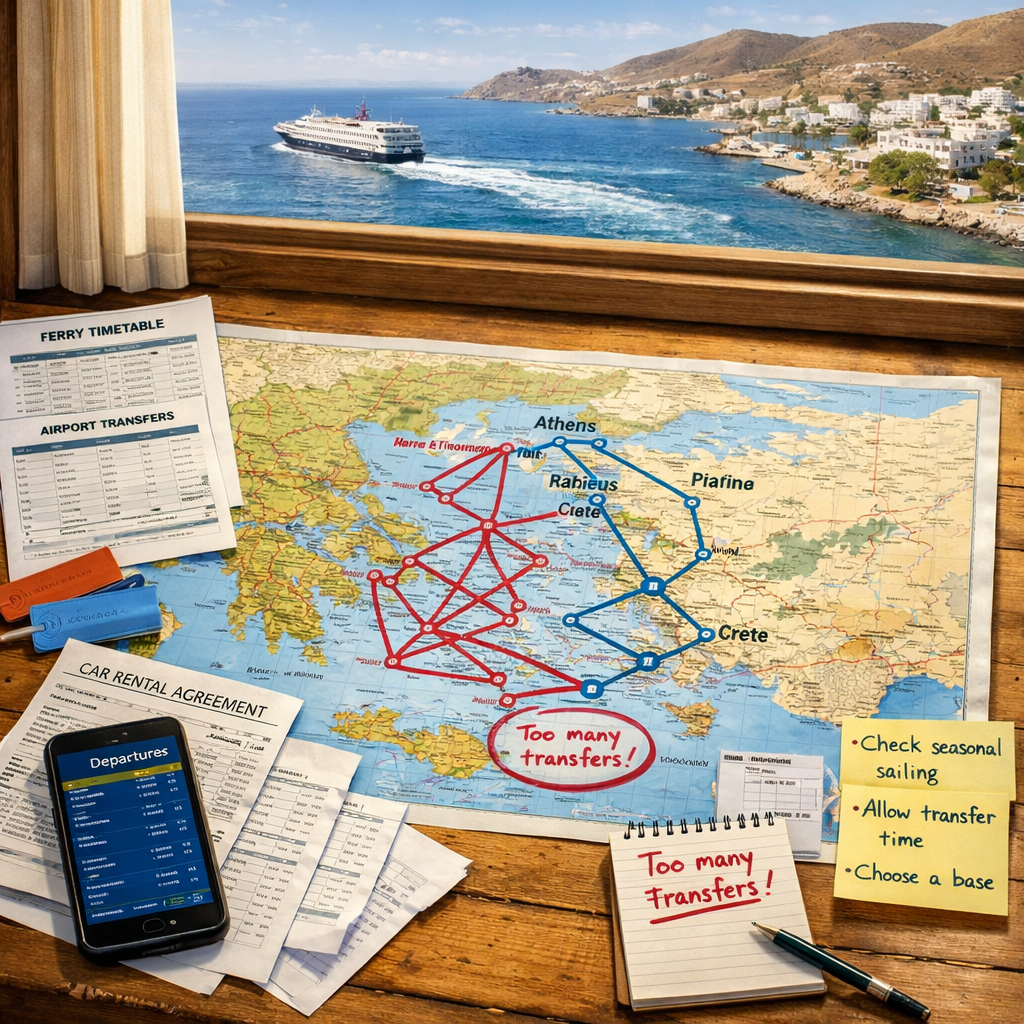
Changing islands every night is poor use of travel time. Ferry delays, port transfers, luggage handling, and hotel check-in can consume half a day even when the crossing itself is short.
I’d recommend two bases for seven nights and three bases only when the route is direct and well timed. Keep the final night near your departure airport if a separate ferry or domestic flight is involved.
The car-rental assumption
You do not need a car everywhere. Athens, many port towns, and some compact islands work with buses, taxis, walking, and organized excursions. A car is more useful on Crete, the Peloponnese, Kefalonia, and areas with infrequent bus service.
Do not assume your rental car can travel between islands. Some companies restrict ferry transport, and vehicle drop-off locations may not match your route.
Timing, Budget, and Booking Decisions
The best travel month depends on your priorities. June and September often offer warm swimming conditions with less pressure than the peak weeks of July and August, while May and October can be better for walking and archaeological sites but less predictable for beach weather.
Accommodation prices vary sharply by island, neighborhood, room type, and date. Santorini and Mykonos typically require a larger lodging budget than less internationally known islands, but a higher price does not guarantee an easier route or better beach access.
Allowance for travel days
A ferry day should include hotel-to-port transport, the recommended boarding window, sailing time, disembarkation, and the trip to your next room. For a departure from Piraeus, Athens traffic can affect the final transfer even when the port is geographically close.
Build one flexible afternoon into a weeklong itinerary. That space absorbs a delayed ferry, rough-weather cancellation, or a spontaneous inland excursion.
Booking priorities
Reserve international flights first, then time-sensitive ferries and high-demand lodging. For flexible plans, refundable hotels are often worth the difference, especially when you are relying on seasonal routes.
Keep confirmation numbers, passport details, and ferry tickets accessible offline. Cell service can be inconsistent on remote islands and during port boarding.
A simple decision rule
Choose an airport-connected island when your trip is short or your arrival is late. Choose a ferry-connected island when you want island hopping and can absorb a longer transfer. Choose the mainland when history, food, and road travel matter more than a postcard coastline.
Conclusion
Choose the route before the island. For five to seven nights, select Athens plus one nearby island, or stay on Crete, Corfu, or another airport-connected destination. For longer trips, add a second island only after confirming a direct seasonal ferry. That one decision leaves more time for Greece and less time waiting in ports.
Frequently Asked Questions
How many Greek islands should I visit in one week?
Visit one or two islands in a seven-night trip. Add a third only when ferry crossings are short, direct, and scheduled at convenient times. A second island with a different character usually adds more value than several rushed stops.
Is Greece easy to visit without renting a car?
Yes, especially in Athens, major port towns, and islands with frequent buses. A car becomes more useful in Crete, the Peloponnese, Kefalonia, and remote beach areas where buses run infrequently or end early.
Which Greek island is easiest to reach from Athens?
The easiest choice depends on the date, but Naxos, Paros, Mykonos, and Santorini usually have strong Cycladic connections from Piraeus or Rafina during the main season. Always check the exact sailing calendar before booking a hotel.
Are Greek islands warm in October?
Many remain comfortable for sightseeing, but swimming and ferry conditions are less predictable than in July or August. Crete and Rhodes often offer a longer warm season, while smaller northern islands may feel cooler and have reduced services.