
Imagine standing at the foot of the Parthenon as the morning light turns the ancient marble a warm, honeyed gold. Around you, 2,500 years of history press in from every direction — the same stones that Pericles commissioned, that philosophers debated beneath, that armies fought and died to control. This is what it feels like to stand inside a living ancient Greek monument, and nothing you read or watch beforehand quite prepares you for the moment.
Greece holds more UNESCO World Heritage Sites per square mile than almost anywhere on Earth, and the country’s ancient ruins are not museum exhibits frozen behind glass — they are open-air experiences you walk through, breathe in, and feel in your bones.
This guide covers the best ancient Greek monuments you should visit in 2026: what to see, why it matters historically, exactly how to get there, and the insider knowledge that turns a good trip into an unforgettable one.
The Acropolis of Athens: Greece’s Most Iconic Monument
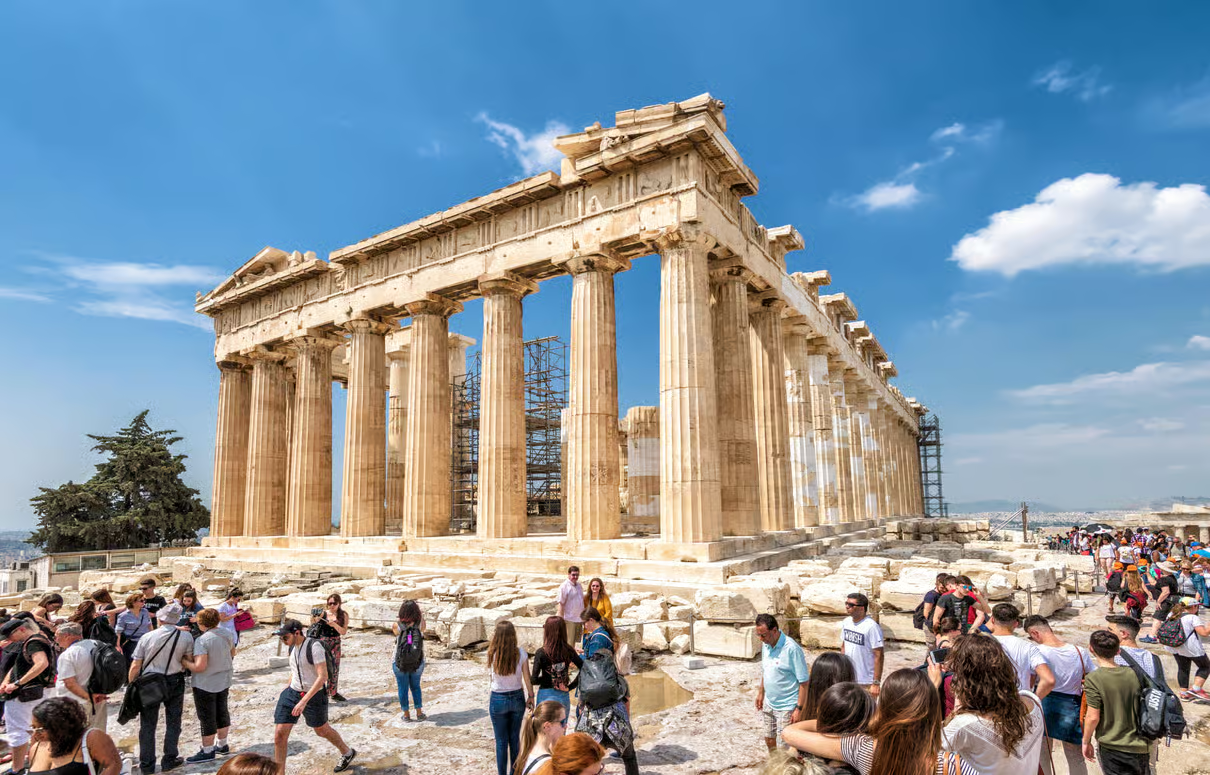
No list of ancient Greek monuments begins anywhere but here. The Acropolis — meaning “high city” in Greek — is a flat-topped limestone rock rising 156 meters above Athens, and what sits on top of it represents the absolute pinnacle of Classical Greek achievement.
Construction of the Parthenon began in 447 BCE under the direction of the sculptor Pheidias, at the command of the statesman Pericles. It was not simply a temple — it was a declaration that Athens had won, that democracy worked, and that Greek civilization was worth celebrating in marble for eternity. The temple was dedicated to Athena Parthenos, the city’s patron goddess, and inside it once stood a 12-meter gold-and-ivory statue of her.
Over the centuries, the Parthenon served as a Byzantine church, a Catholic cathedral, and an Ottoman mosque before a Venetian cannonball ignited the gunpowder stored inside in 1687 and blew out its center. What you see today is the result of ongoing restoration — and it is still magnificent.
What You’ll Actually See
The Acropolis complex contains four major structures:
- The Parthenon — The largest Doric temple ever built, still commanding despite its partial ruin. Walk around the full perimeter; the east and west pediments show the most surviving sculptural detail.
- The Erechtheion — Famous for its Porch of the Caryatids, where six draped female figures serve as columns. (The originals are in the Acropolis Museum; what you see on-site are high-quality replicas.)
- The Propylaea — The monumental gateway to the Acropolis. Climb through it slowly — this is the entrance ancient Athenians used during the Panathenaic procession.
- The Temple of Athena Nike — Small, elegant, and easy to miss. It stands at the southwest bastion and celebrates Athenian victory over Persia.
Allow at least 2–3 hours on the Acropolis itself, then budget another 1–2 hours for the New Acropolis Museum
at the base (a world-class museum that houses the original Caryatids and surviving Parthenon sculptures — do not skip it).
2026 Visitor Information
- Opening hours: Generally 8:00 AM – 8:00 PM (summer), shorter hours off-season.
- Ticket prices: A combined Athens multi-site ticket covers the Acropolis plus six other major sites (Ancient Agora, Roman Agora, Kerameikos, Temple of Olympian Zeus, Lykeion, and Hadrian’s Library). Single-site tickets are also available.
- Best time to visit: First entry (8:00 AM) or the last 90 minutes before closing. Avoid 10:00 AM–2:00 PM in July and August — the heat and crowds combine brutally.
- Getting there: Metro Line 2 (Red) to Akropoli station. A 5-minute walk brings you to the south entrance on Dionysiou Areopagitou street.
- Crowd tip: Book tickets online in advance. Summer weekends can see 10,000+ visitors per day.
🏛 Local Insider Tip: Visit the Acropolis Museum the evening before your Acropolis climb. Seeing the original sculptures up close — especially the Parthenon frieze — makes the next morning’s climb dramatically more meaningful. The museum is open late on Fridays.
Ancient Delphi: Where the Oracle Spoke and History Listened
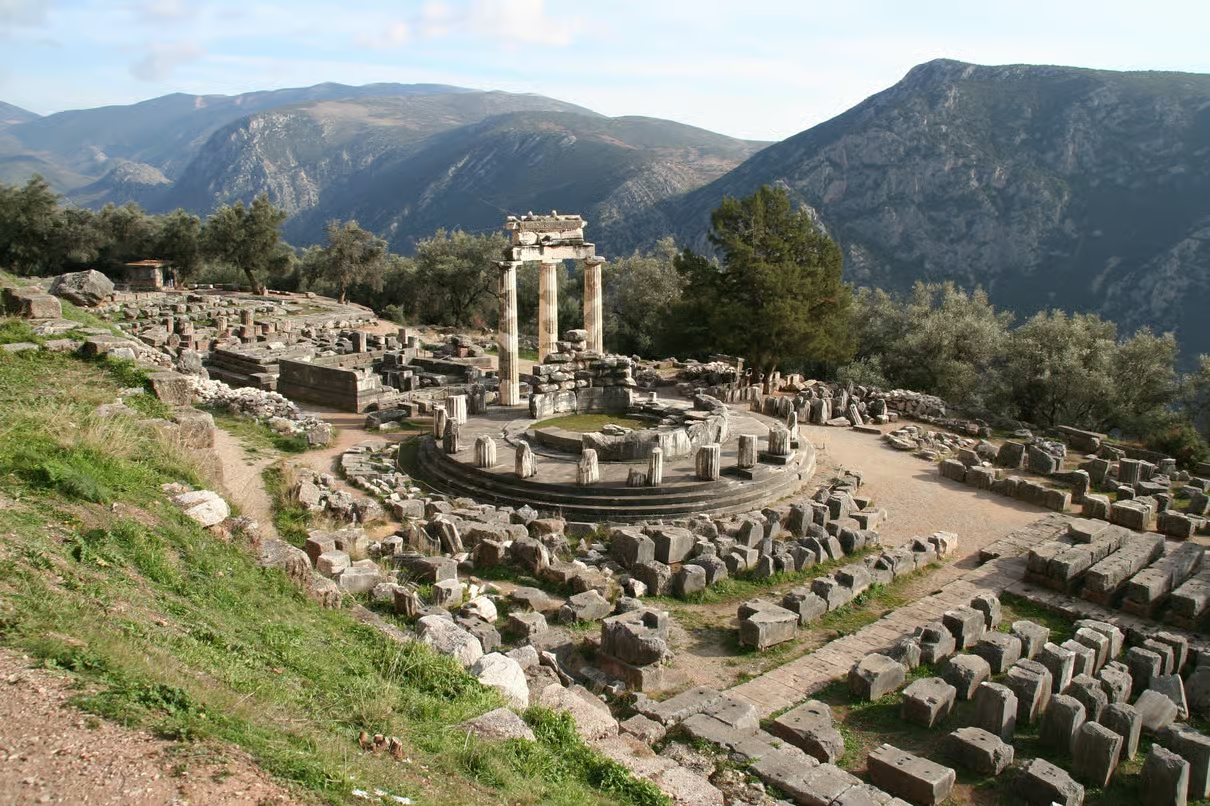
If the Acropolis is Greece’s most famous monument, Ancient Delphi is its most mysterious. Perched on the steep slopes of Mount Parnassus, about 2.5 hours northwest of Athens, Delphi was considered the center of the world by the ancient Greeks — the omphalos, or navel of the earth.
For nearly a thousand years, from around 800 BCE to 390 CE, kings, generals, and ordinary citizens made the long pilgrimage here to consult the Oracle of Delphi — a priestess called the Pythia who sat above a natural fissure in the earth, inhaled vapors, and delivered cryptic prophecies that shaped empires. Croesus of Lydia asked whether to attack Persia; the Oracle told him that if he did, a great empire would fall. He attacked — and his own empire fell.
The sanctuary’s wealth was extraordinary. City-states from across the Greek world sent tribute here, constructing elaborate treasury buildings along the Sacred Way to advertise their power and piety. Delphi was, in modern terms, a combination of Vatican City, the United Nations, and Las Vegas.
What You’ll Actually See
The archaeological site is large and requires a good 2–3 hours to explore properly:
- The Sacred Way — Walk the same uphill path that ancient pilgrims walked, past the ruins of numerous treasury buildings (the Athenian Treasury is the best-preserved).
- The Temple of Apollo — Six columns of the original structure still stand, but the platform and surrounding ruins let you understand the temple’s enormous scale. The admonition “Know Thyself” was inscribed at its entrance.
- The Ancient Theater — Carved into the hillside above the temple, it seats 5,000 and offers one of the most dramatic views in Greece: the ruins below, the olive groves of the valley, and the mountains beyond.
- The Stadium — A 10-minute walk above the theater brings you to the best-preserved ancient stadium in Greece, still clearly laid out with stone starting blocks.
- The Delphi Archaeological Museum — Immediately adjacent to the site. The star exhibit is the Bronze Charioteer (478 BCE), one of the finest surviving bronze sculptures from antiquity. Allow 1.5 hours.
2026 Visitor Information
- Opening hours: Generally 8:00 AM – 8:00 PM (summer). Museum and site may have coordinated but slightly different hours.
- Ticket prices: Combined site + museum ticket available.
- Best time to visit: April–May or September–October. The site sits at elevation (570m), making summer heat more manageable than Athens, but the path is steep — start early.
- Getting there: Day trip by rental car or organized tour from Athens (2.5 hrs). KTEL buses run from Athens’ Liosion terminal but require planning. Most visitors combine Delphi with Meteora on a 2-day trip.
🏛 Local Insider Tip: Walk past the main site entrance and continue uphill to the Castalian Spring — where ancient pilgrims ritually purified themselves before consulting the Oracle. It’s often deserted, atmospheric, and free to visit. The water still flows.
Ancient Olympia: Birthplace of the Olympic Games
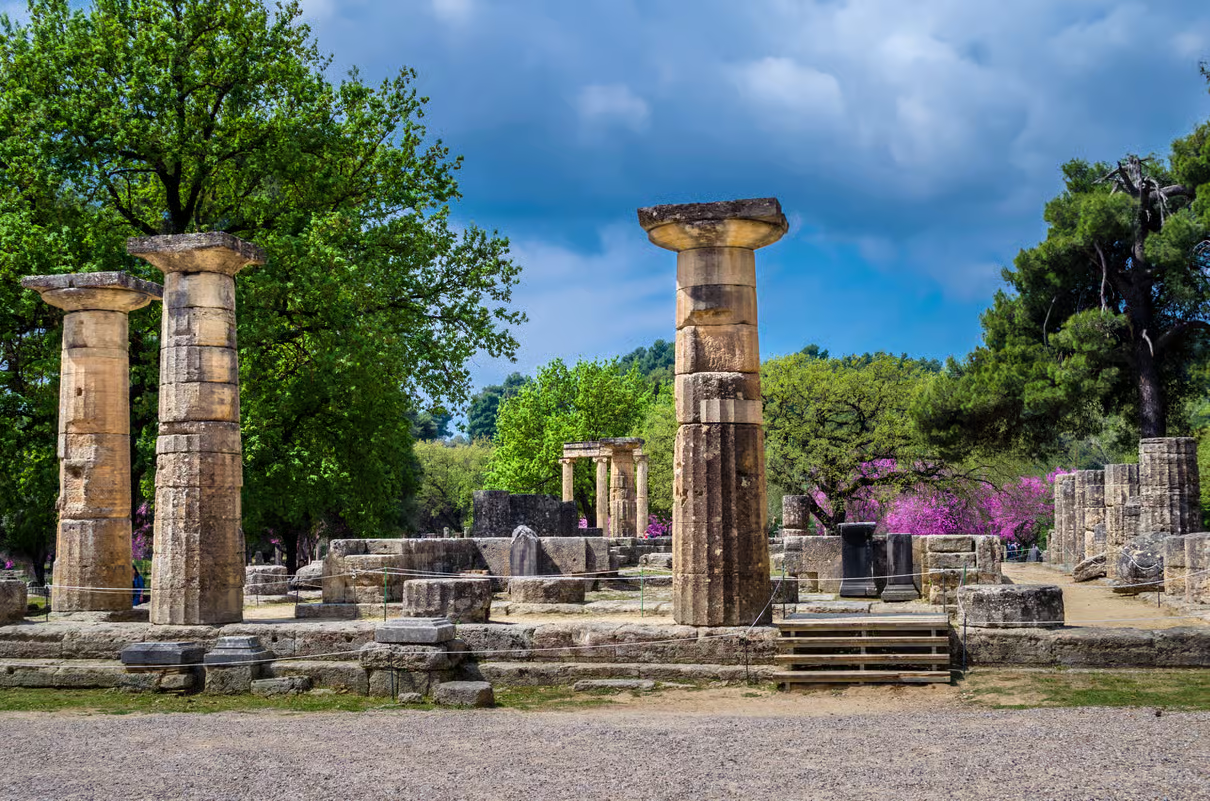
There are ancient sites that impress you with their grandeur, and there are sites that move you with their meaning. Ancient Olympia, in the western Peloponnese, does both.
Every four years from 776 BCE to 393 CE — for over a thousand uninterrupted years — athletes from across the Greek world converged on this sacred valley to compete in honor of Zeus. Wars were paused. Ambassadors traveled under safe passage. The Games were not just sport; they were one of the most powerful forces for pan-Greek unity in the ancient world.
The sanctuary’s centerpiece was the Temple of Zeus, completed around 457 BCE and considered one of the Seven Wonders of the Ancient World in its original form. Inside stood Pheidias’s colossal Statue of Zeus — a 13-meter figure of gold and ivory seated on a throne, so overwhelming in scale that the ancient writer Strabo claimed it appeared that if Zeus stood up, he would lift the roof off the temple. The statue is gone; the temple is an earthquake-scattered ruin. But the drama of what once stood here is still palpable.
What You’ll Actually See
- The Temple of Zeus — The massive fallen drums of its columns lie exactly where they collapsed during earthquakes in the 5th and 6th centuries CE. Walking among them gives you an almost physical sense of the temple’s original scale.
- The Temple of Hera — Older and better preserved than Zeus’s temple, with standing columns and a serene atmosphere. The Olympic flame is lit here every four years before the modern Games.
- The Ancient Stadium — Walk through the original tunnel entrance and stand on the track where ancient Olympic athletes once competed. The stone starting blocks are still in place.
- The Workshop of Pheidias — The building where the great sculptor created the Statue of Zeus has been identified archaeologically; his tools and molds were found here.
- The Archaeological Museum of Olympia — One of Greece’s finest regional museums. The reconstructed pediments of the Temple of Zeus and the original Hermes of Praxiteles (4th century BCE) are extraordinary.
2026 Visitor Information
- Opening hours: Generally 8:00 AM – 8:00 PM (summer).
- Ticket prices: Combined site + museum ticket available.
- Best time to visit: Olympia can be very hot in July–August (inland valley, little shade). Spring and fall are ideal. Arrive when the site opens to have the stadium almost to yourself.
- Getting there: Train from Athens to Pyrgos (4 hrs), then local bus to Olympia. More practically: rent a car and combine with a broader Peloponnese road trip (Mycenae → Nafplio → Epidaurus → Olympia works beautifully as a loop).
🏛 Local Insider Tip: At the Ancient Stadium, you can run a lap on the original track — the same 192-meter distance as the ancient foot race. There’s an unofficial tradition of attempting it. The staff generally smile and look the other way.
The Citadel of Mycenae: The World of Agamemnon
Standing at the Lion Gate of Mycenae, you feel the weight of myth made real. This is the world of Agamemnon, of the Trojan War, of Homer’s Iliad — and it turns out that world was not entirely fiction.
Mycenae, in the northeastern Peloponnese, was the dominant power in the Bronze Age Greek world from roughly 1600 to 1100 BCE. The Mycenaeans built in a style called “Cyclopean masonry” — using blocks of limestone so enormous that later Greeks assumed only the mythological giants called Cyclopes could have moved them. The walls of Mycenae, still standing after 3,200 years, are 6 meters thick in places.
Heinrich Schliemann, the obsessive German archaeologist who also excavated Troy, arrived here in 1876 and immediately found treasure: royal shaft graves filled with gold masks, weapons, and jewelry. Staring at a golden death mask, he reportedly telegraphed the King of Greece: “I have gazed upon the face of Agamemnon.” He was wrong about the mask (it predates Agamemnon by centuries), but the drama of the discovery captured the world’s imagination.
What You’ll Actually See
- The Lion Gate (1250 BCE) — The oldest surviving monumental sculpture in Europe. Two lions flank a central column above the entrance. Walk through it slowly.
- Grave Circle A — The royal shaft graves where Schliemann found the gold masks. The graves themselves are marked and explained.
- The Treasury of Atreus (also called the Tomb of Agamemnon) — A short walk from the main site, this beehive-shaped tholos tomb is an engineering marvel. Its corbelled dome, 14.5 meters high, stood as the world’s largest unsupported dome for over a thousand years. Step inside — the interior silence and scale are remarkable.
- The Palace remains — Climb to the summit for panoramic views of the Argive plain and the ruins of the Mycenaean palace.
2026 Visitor Information
- Opening hours: Generally 8:00 AM – 8:00 PM (summer).
- Ticket prices:
- Best time to visit: Morning, before tour buses arrive around 10 AM. The site has limited shade.
- Getting there: 1.5-hour drive from Athens. Easy day trip, or overnight in nearby Nafplio (Greece’s most beautiful small town, and a perfect Peloponnese base).
🏛 Local Insider Tip: The Treasury of Atreus is a 5-minute walk down the road from the main entrance — many visitors overlook it entirely. Don’t. Stand inside the tomb and clap once: the acoustics create an eerie, resonant echo that feels appropriately ancient.
Knossos Palace, Crete: Labyrinth of the Minoans
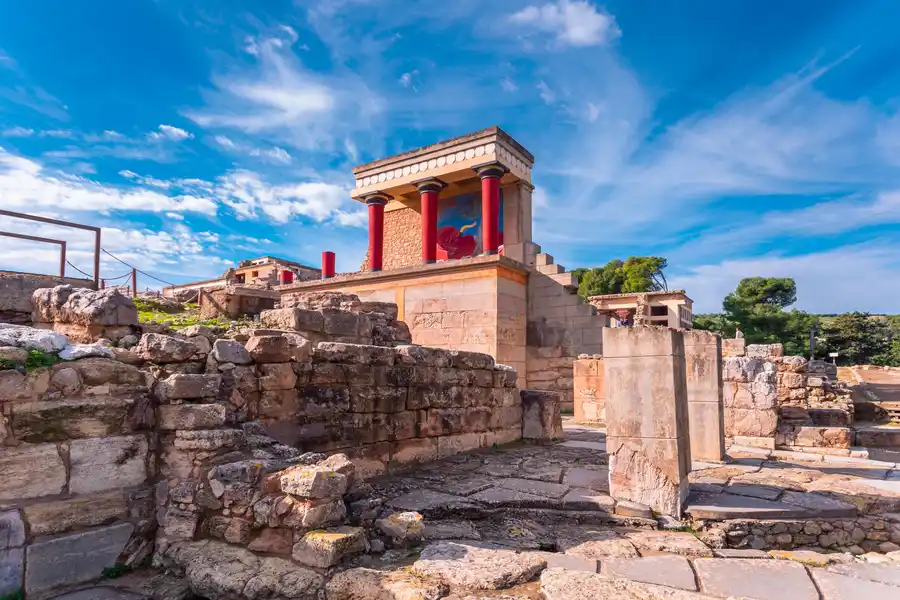
Knossos, 5 kilometers south of Heraklion on Crete, is the largest Bronze Age archaeological site in the Aegean — and one of the most controversial. The palace of Knossos was the center of the Minoan civilization, Europe’s first advanced urban culture, which flourished from around 2000 to 1450 BCE. The Minoans had indoor plumbing, sophisticated drainage systems, multi-story buildings, and a writing system (still not fully deciphered) before mainland Greek civilization had fully developed.
The connection to myth is direct: this is the palace of King Minos, where the legendary Labyrinth imprisoned the Minotaur — the half-man, half-bull monster fed on Athenian youth until Theseus arrived to kill it. Whether or not you believe the myth (and archaeologists have found Minoan bull-worship imagery everywhere at Knossos), the palace’s complex, maze-like layout of interlocking rooms and corridors makes the myth feel entirely plausible.
The British archaeologist Sir Arthur Evans excavated Knossos starting in 1900 and controversially reconstructed much of the site using concrete and his own interpretations. Scholars debate his accuracy; visitors generally find the result helps them visualize a living palace in a way that pure ruins cannot.
What You’ll Actually See
- The Central Court — The heart of the palace, where the famous bull-leaping ritual likely took place.
- The Throne Room — Astonishingly, the oldest throne still in situ in Europe. The stone seat of the Minoan king, flanked by reproductions of Griffin frescoes, sits exactly where it was found.
- The Grand Staircase — One of Evans’s most ambitious reconstructions, showing the multi-story sophistication of Minoan architecture.
- The Heraklion Archaeological Museum — This is where the original frescoes are kept, along with the famous snake goddess figurines and the Phaistos Disc. The museum is arguably as important as the site itself. Budget a half-day for it.
2026 Visitor Information
- Opening hours: Generally 8:00 AM – 8:00 PM (summer).
- Ticket prices:
- Best time to visit: Arrive at opening — Knossos receives enormous numbers of cruise ship day-trippers from mid-morning onward. By 11 AM it can be extremely crowded.
- Getting there: City bus from Heraklion’s central bus station (Bus 2) runs frequently and takes about 20 minutes. Taxis are cheap from the city center.
🏛 Local Insider Tip: Hire a licensed guide at the entrance rather than relying solely on the site’s signage. Knossos is genuinely confusing without context, and a good guide makes the reconstructed frescoes and palace layout come alive in 90 minutes. It’s worth every euro.
Delos Island: The Sacred Island at the Center of the Cyclades
Of all the ancient Greek monuments in this guide, Delos demands the most effort to reach — and rewards it most unexpectedly. This tiny, flat island (5 km long, barely 1 km wide) in the heart of the Cyclades was one of the most sacred places in the ancient Greek world, believed to be the birthplace of the twin gods Apollo and Artemis.
For centuries, Delos was forbidden to the living and the dying. The island functioned as a massive religious and commercial hub, eventually becoming one of the Mediterranean’s busiest trading ports in the 2nd century BCE, with a population approaching 30,000. Then pirates sacked it in 88 BCE, and it was effectively abandoned.
What that means for modern visitors is remarkable: Delos is essentially an entire ancient city, frozen in time and almost entirely unexcavated beneath the soil. What is visible is already extraordinary.
What You’ll Actually See
- The Terrace of the Lions — Five archaic marble lions (out of an original 9–12) guard the Sacred Lake where Apollo was born. The originals are in the on-site museum; replicas stand on the terrace.
- The Sanctuary of Apollo — Three successive temples dedicated to Apollo, along with remains of the famous Delian Treasury.
- The Ancient Theatre — A well-preserved 5,500-seat theater overlooking the entire island and surrounding sea.
- The House of Dionysus — One of several wealthy merchant houses with stunning mosaic floors still visible in situ.
- Mount Kynthos — A 20-minute climb to the island’s highest point (113m) rewards you with a view of the entire Cyclades. On a clear day you can see Mykonos, Naxos, Paros, and Syros.
2026 Visitor Information
- Getting there: Day boats depart from Mykonos Old Port, approximately 30 minutes. Some boats also operate from Naxos and Paros.
- Important: There is no accommodation on Delos. You must return on the afternoon boat (typically 3:00 PM departure from Delos). Most visitors have 3–4 hours on the island.
- Ticket prices: Site + museum combination.
- Best time to visit: May or October. July and August on Delos are punishingly hot with no shade and no fresh water available on the island — bring more than you think you need.
🏛 Local Insider Tip: Bring lunch. There is one small café/kiosk on Delos, but supplies are limited and expensive. Pack a proper picnic and eat it at the top of Mount Kynthos with that staggering view — it’s one of the finest lunches in Greece, regardless of what’s in your bag.
The Ancient Theater of Epidaurus: The Most Perfect Sound in the World
Here is a test. Stand at the center of the Ancient Theater of Epidaurus, at the round stone orchestra at the bottom. Have a friend climb to the very back row — the 55th tier, 74 rows above you. Tear a piece of paper. They will hear it. Every word you whisper, every coin you drop, every crinkle of a wrapper travels up through 14,000 seats with crystalline clarity.
The acoustics of Epidaurus are not accidental. Built around 340 BCE by the architect Polykleitos the Younger, the theater was designed with precise mathematical proportions — a 20-degree orchestra circle, specific seat angles, and a limestone surface that reflects low frequencies and absorbs ambient noise — to create an acoustic environment that modern engineers still study and cannot fully replicate with contemporary materials.
The theater sits within the Sanctuary of Asclepius, the ancient Greek god of healing. Epidaurus was essentially a spiritual spa and healing center — patients came from across the Mediterranean, underwent ritual purification, slept in sacred dormitories hoping for healing visions from the god, and were treated by what we would now call the world’s first medical professionals. The combination of theater (entertainment), baths (physical healing), and religious ritual made Epidaurus one of the most visited sanctuaries in the ancient world.
What You’ll Actually See
- The Theater — 55 tiers of white limestone seating, almost entirely original (the lower 34 rows date to the 4th century BCE; the upper 21 were added in the 2nd century BCE). Sit in different sections; the acoustics shift noticeably.
- The Sanctuary ruins — The foundations of the Temple of Asclepius, the Tholos (a mysterious circular building), the Abaton (sacred sleeping hall), and ancient baths.
- The Archaeological Museum of Epidaurus — Small but excellent, with original architectural sculptures and medical instruments found in the sanctuary.
- Modern performances — The theater still hosts performances every summer as part of the Athens Epidaurus Festival (typically June–August). Watching a Greek tragedy performed where it was originally performed is a profound experience.
2026 Visitor Information
- Opening hours: Generally 8:00 AM – 8:00 PM (summer).
- Ticket prices:
- Festival tickets: Book Athens Epidaurus Festival performances well in advance — popular performances sell out months ahead
- Getting there: 2.5-hour drive from Athens (via Corinth). Day trip possible but tiring; overnight in Nafplio (40 minutes away) is strongly recommended.
🏛 Local Insider Tip: If you visit in summer, check the festival schedule. Attending an ancient Greek tragedy — Sophocles, Euripides, Aristophanes — performed in this theater on a warm evening under the stars, in the exact space it was written for, is the single most memorable thing you can do in Greece. Non-Greek speakers follow easily with the printed program.
The Ancient Agora of Athens: Democracy’s Birthplace
While the Acropolis towers above Athens as its spiritual monument, the Ancient Agora was where Athenian life actually happened. The Agora — meaning “gathering place” — was the commercial, political, and philosophical heart of the city for nearly a thousand years.
This is where Socrates walked and talked, stopping Athenians to ask them inconvenient questions about justice and virtue. Where Demosthenes practiced oratory. Where the concept of democracy was debated, refined, and occasionally overturned. The law courts, the council chambers, the commercial stalls, the temples, the fountains — the Agora contained all of it in one crowded, animated space.
What You’ll Actually See
- The Temple of Hephaestus — The best-preserved ancient Greek temple in existence, period. More complete than the Parthenon, with its full colonnade, pediment sculptures, and even its original bronze doors’ impressions still visible in the threshold. Often overlooked because it sits quietly at the edge of the Agora while tourists rush to the Acropolis.
- The Stoa of Attalos — Reconstructed in the 1950s using original materials and ancient construction methods, this two-story colonnaded building now serves as the Agora Museum and gives you an accurate sense of what ancient Athenian commercial architecture looked like.
- The Bema — The speaker’s platform where Athenian citizens addressed the assembly.
- The Middle Stoa, South Stoa, and Odeon of Agrippa — More ruins spread across the site, requiring time and some imagination to piece together.
2026 Visitor Information
- Opening hours: Generally 8:00 AM – 8:00 PM (summer).
- Ticket prices: Included in the Athens combined multi-site ticket.
- Getting there: Metro Line 1 (Green) to Monastiraki station. The Agora entrance is a 3-minute walk.
- Best time to visit: Late afternoon — the low sun illuminates the Temple of Hephaestus dramatically, and the site thins out considerably after 4 PM.
🏛 Local Insider Tip: Buy a coffee at the café in the Stoa of Attalos and sit on the shaded steps looking out over the Agora. With the Acropolis rising behind you and the ruins spreading before you, you’re sitting in one of the most historically layered views in Western civilization. Take your time.
Hidden Gems: Lesser-Known Ancient Sites Worth Your Time
The eight monuments above are the headline acts. But Greece’s archaeological richness goes far deeper. These four sites reward the curious traveler willing to venture beyond the standard itinerary:
Akrotiri, Santorini
Buried under volcanic ash when the Minoan-era eruption destroyed the island around 1627 BCE, Akrotiri is the “Pompeii of the Aegean.” A sophisticated Bronze Age town — with multi-story buildings, indoor plumbing, and vivid frescoes — preserved in extraordinary detail. Covered by a modern protective canopy, it offers an intimate, uncrowded alternative to Knossos.
Ancient Messene, Peloponnese
One of Greece’s most undervisited major sites, Ancient Messene contains a near-complete ancient city: a theater, stadium, baths, temples, agora, and 9 kilometers of circuit walls, all remarkably preserved. Almost no tourists. Locals picnic in the ruins on weekends.
Vergina (Aigai), Northern Greece
The royal tombs of the Macedonian kings, including the tomb of Philip II (father of Alexander the Great), discovered in 1977. The gold larnax (burial chest) and Philip’s diadem are on display in the spectacular underground museum. A must for anyone interested in Alexander the Great.
Dodona, Epirus
Greece’s oldest oracle, predating Delphi, sits in a remote valley in northwestern Greece. The ancient theater is enormous (seats 17,000) and perfectly preserved, yet almost always empty of tourists. The drive through Epirus to get there is itself a journey through wild, beautiful Greece few visitors ever see.
Planning Your Ancient Greece Itinerary
Greece rewards planning. Here are three practical frameworks:
7-Day Mainland Focus
- Days 1–3: Athens — Acropolis, Acropolis Museum, Ancient Agora, National Archaeological Museum
- Day 4: Day trip to Delphi
- Days 5–6: Peloponnese road trip — Mycenae, Nafplio, Epidaurus
- Day 7: Olympia (en route to Athens for departure, or fly home from Kalamata)
10-Day Mainland + Islands
- Days 1–3: Athens (same as above)
- Day 4: Delphi day trip
- Days 5–7: Peloponnese — Mycenae, Nafplio, Epidaurus, Olympia
- Day 8: Fly to Crete — Knossos + Heraklion Museum
- Days 9–10: Mykonos with a full-day Delos excursion
14-Day Grand Tour
Combine the 10-day itinerary above with:
- Days 11–12: Santorini (Akrotiri Bronze Age site + caldera views)
- Days 13–14: Back to Athens, day trip to Ancient Messene or a final Acropolis sunset
Best Months to Visit
April–June and September–October are the ideal windows for visiting ancient sites in Greece. Temperatures are comfortable (20–28°C), crowds are manageable, and the landscape — wildflowers in spring, golden light in fall — adds to the experience. July and August are the hottest and most crowded months; doable, but require early starts and careful planning.
Athens as your base: For a mainland-focused trip, Athens is an ideal hub. From Athens, Delphi, Mycenae, and Epidaurus are all manageable day trips. The city’s transport links (flights, ferries, buses) make it easy to extend into the islands.
Getting around: A rental car transforms a Greek archaeological trip. Public buses reach most major sites but require more time and planning. Athens’ metro is excellent within the city.
Combined Athens ticket: The Athens multi-site ticket covers multiple major monuments and offers significant savings over individual entries.
Practical Tips for Visiting Ancient Sites in Greece in 2026
What to Wear and Bring
- Footwear: Sturdy walking shoes or trail sneakers are essential. Ancient sites involve uneven marble, loose gravel, and steep paths. Do not wear sandals to the Acropolis.
- Sun protection: Hat, sunglasses, and high-SPF sunscreen are non-negotiable from May through October. Ancient sites have almost no shade.
- Water: Carry at least 1.5 liters per person. Many sites have fountains; most don’t.
- Layers: Mountain sites like Delphi and Dodona can be cool in the morning even in summer.
Guided Tours vs. Self-Guided
Both work well, depending on your style. Guided tours provide context that can transform a field of stone columns into a living story — particularly valuable at complex sites like Knossos, the Agora, and Delphi. Self-guided visits with a good book or audio guide offer flexibility and the quiet that group tours rarely allow.
Audio Guides and Apps
- The official Greek Ministry of Culture app provides audio guides for major sites. Download before traveling (connectivity at sites can be poor).
- Rick Steves’ Greece audio tours (free via his website or app) are solid for the Acropolis and Athens.
- Dedicated apps like Tourguidemio are useful for Knossos and Olympia.
Photography
Photography is permitted at virtually all outdoor ancient sites. Drones require special permits (rarely granted for individual tourists). Inside museums, check individual policies — many Greek museums now allow photography without flash.
Accessibility
Most Greek ancient sites involve significant uneven terrain and are not fully accessible for visitors with mobility limitations. The New Acropolis Museum is fully accessible, as is the Stoa of Attalos (Agora Museum). The Acropolis itself has an elevator for visitors with disabilities on the south slope — contact the site administration in advance.
F.A.Q.
The Parthenon on the Acropolis of Athens is widely considered Greece’s most iconic ancient monument — and arguably the most recognizable ancient structure in the world. Built in the 5th century BCE, it remains the defining symbol of Classical Greek civilization and is visited by millions of people each year.
A minimum of 7–10 days allows you to see the main sites on the mainland (Acropolis, Delphi, Mycenae, Epidaurus, Olympia). Adding Crete and the Cyclades (for Knossos and Delos) extends this to 12–14 days. It’s entirely possible to do a meaningful ancient sites trip in a week if you plan carefully and focus on the mainland.
Absolutely. Greece’s ancient sites remain among the most extraordinary human-made landscapes on earth — and unlike many historical destinations, you walk through them, stand in ancient theaters, and touch stones that have witnessed civilizations rise and fall. The experience is qualitatively different from any museum or documentary. For culturally curious travelers, they are the trip.
April to early June and September to October offer the best balance of good weather, comfortable temperatures, and manageable crowds. Ancient sites in peak summer (July–August) can be very crowded and brutally hot with little shade. If summer is your only option, plan to arrive at opening time and finish by noon.
Yes, and many travelers prefer it. Good preparation — reading a solid background book (Mary Beard’s SPQR, Paul Cartledge’s Ancient Greece) before your trip, downloading an audio guide app, and picking up the official site booklet on arrival — can make a self-guided visit deeply satisfying. For complex sites like Knossos and the Agora, a 2-hour guided tour on your first visit, followed by independent exploration, is an excellent combination.
This varies significantly by site. Ancient sites are built on uneven, ancient terrain and most were not designed with modern accessibility in mind. The New Acropolis Museum, the Stoa of Attalos, and several regional museums are fully wheelchair accessible. The Acropolis has an elevator on the south slope. Knossos has partially paved paths. Contact individual sites in advance and review the Greek Ministry of Culture’s accessibility information.
Conclusion: Why Ancient Greece Still Changes People
Travelers who come to Greece for the beaches often leave talking about the ruins. There’s something that happens when you stand inside a 2,500-year-old theater, or pass through the Lion Gate of Mycenae, or watch the light change on the Parthenon at dusk — something that photographs don’t capture and words only partially convey.
These ancient Greek monuments are not relics of a dead civilization. They are the foundations of the world we live in: democracy, philosophy, theater, medicine, the Olympic ideal, the very alphabet you’re reading now. Visiting them is less like going to a museum and more like meeting your own origins.
Greece’s ancient sites in 2026 are well-maintained, generally well-explained, and more accessible than ever — but they still reward the traveler who arrives prepared, curious, and willing to slow down.
Start planning your ancient Greece journey at MyGreekPath.com. We’ve covered every major destination in detail — with local insights, practical itineraries, and the kind of honest advice that only comes from people who live here. Browse our destination guides, download our free Greece travel planning guide, or subscribe to our newsletter for seasonal updates, new articles, and insider tips delivered straight to your inbox.
Greece has been waiting 2,500 years. It can wait a little longer — but not forever.
ATTENTION PLEASE!!
All ticket prices and opening hours noted in this article are subject to change. ⚠️ Verify all operational details via the Greek Ministry of Culture website or official site pages before your visit in 2026.
Greek Ministry of Culture — official site listings and ticket information