
Forget Santorini sunsets. Winter Greece is a completely different country — and it might just be the best version of it.
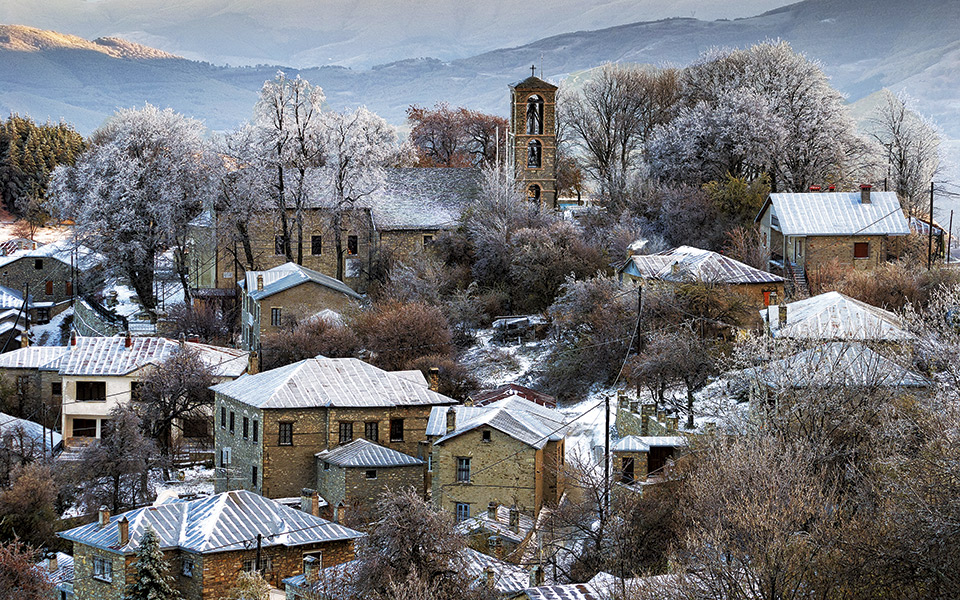
Most people picture Greece as a summer destination — whitewashed houses against a deep blue sea, crowded ferries, and beach bars playing loud music until sunrise. And sure, that Greece exists. But there is another Greece that very few travelers ever get to see.
Between November and March, the mainland transforms into something quieter, colder, and infinitely more soulful. Snow settles on mountain peaks. Fireplaces crackle inside centuries-old stone guesthouses. Village tavernas serve slow-cooked stews to a dining room of three. The prices drop, the crowds vanish, and what remains is something closer to the real heartbeat of the country.
This is not a list of the usual suspects. You will not find Arachova’s crowded main street or the well-documented cafés of Nafplio here. Instead, these are seven mainland destinations where winter feels like a secret — places where the landscape shifts dramatically, the locals still outnumber the visitors, and every meal feels like it was made specifically for you.
If you have been wondering where to go in Greece in January, February, or March, start here.
Why Visit Greece in Winter?
Before we get into the destinations, a quick word for the skeptics: yes, Greece in winter is absolutely worth it.
The country sees roughly 33 million tourists a year, and the vast majority arrive between June and September. That means winter travel in Greece offers something increasingly rare in southern Europe — space. You get the same dramatic landscapes, the same extraordinary food, and the same warm hospitality, but without fighting for a restaurant table or a parking spot.
Prices reflect this shift. Accommodation in mainland Greece during winter can cost 40-60% less than peak season. Flights to Athens are significantly cheaper, and car rental rates drop to a fraction of their summer highs.
But the real argument for off-season Greece is not about saving money. It is about experiencing a side of the country that most visitors never encounter: snow-dusted gorges, thermal springs steaming in the cold air, mountain trails through chestnut forests, and villages where the rhythm of life has barely changed in decades.
You will need a car for most of these destinations — public transport to remote mainland areas is limited in winter. But that is part of the appeal. A winter road trip through Greece is one of the most underrated drives in all of Europe.
Related: Best Time to Visit Greece — A Month-by-Month Guide
1. Zagorochoria, Epirus — Where Stone Meets Snow
![Stone arch bridge in Zagorochoria covered in snow, surrounded by bare trees and grey sky]
Best for: Hikers, architecture lovers, and anyone who wants to feel like they have stepped into another century.
Why Go
Tucked into the folds of the Pindus Mountains in northwestern Greece, the Zagorochoria (or Zagori villages) are a cluster of 46 traditional settlements connected by old stone paths and arched bridges. In summer, they attract a steady flow of hikers. In winter, they belong almost entirely to the locals and a handful of travelers who know what they are looking for.
The villages are built from the same grey stone as the mountains around them, which means that in winter — when the sky turns heavy and snow blankets the rooftops — the entire landscape looks like it was carved from a single block. The Vikos Gorge, one of the deepest in the world relative to its width, takes on a completely different character under a dusting of frost. Bare trees line the ridges, and the silence is almost physical.
What to Do
Walk the ancient kalderimi — the hand-laid stone paths that wind between villages. The route from Vitsa to Koukouli takes about an hour and passes over the famous three-arched Plakidas Bridge. If the weather cooperates, the trail down to the Voidomatis River (one of the cleanest rivers in Europe) is spectacular even in winter, though you will want proper hiking boots.
Visit the Rizarios Exhibition Center in Monodendri for a glimpse into the region’s cultural history. Drive to the Oxya Viewpoint for a vertiginous look into the Vikos Gorge — on a clear winter morning, with clouds filling the canyon below you, it is one of the most dramatic views in Greece.
For something indulgent, the natural stone pools at Papingo are still accessible in winter (though swimming requires a certain resilience to cold).
Where to Stay & Eat
Aristi Mountain Resort is in the village of Aristi. It is a unique place with stone buildings. Inside, it is modern and stylish. The lobby has a fireplace that becomes the social center each evening. For something more intimate, Mikro Papingo 1700 Hotel and Spa in Mikro Papingo offers rooms with mountain views and a small wellness area.
For dinner, seek out Salvia in Vitsa. The menu changes with what is available. In winter, this means hearty pies. The Epirus region is known for its handmade pitas. You can also find slow-braised meats and local cheeses. Order the kontosouvli (spit-roasted pork) if it is on — and pair it with tsipouro from the barrel.
Getting There
Zagorochoria is about a 4.5-hour drive from Athens. It is also around 30 minutes from Ioannina, which has a small airport for domestic flights. Ioannina is worth a visit. You can walk by the lake, take a boat to the island, and eat at an old-town taverna. After that, head into the mountains.
Insider Tip: The road from Ioannina to Zagori is well-maintained, but some village-to-village roads can get icy in January and February. Snow chains are a smart addition to your rental car. Also, call your hotel or guesthouse before arriving — some close for brief periods in deep winter if bookings are low.
2. Pelion Peninsula, Thessaly — The Mountain That Touches the Sea
![Traditional Pelion village with slate roofs, surrounded by winter greenery and mist]
Best for: Couples, foodies, and travelers who want mountains and coastline in the same weekend.
Why Go
The Pelion Peninsula is a place of mythological proportions — literally. In Greek mythology, it was the homeland of the centaurs and the summer retreat of the gods. Today, it is still one of the most atmospheric places in mainland Greece. Here, thick forests of chestnut, oak, and beech lead to hidden coves by the Aegean Sea.
What makes Pelion unique in winter is its duality. One side of the peninsula faces the Pagasetic Gulf and stays relatively mild. The other climbs steeply into mountains that regularly see snow from December onward. You can drink coffee overlooking a calm winter sea in the morning and be hiking through a snow-covered forest by afternoon.
The villages here—Makrinitsa, Portaria, Tsagarada, Vizitsa, and Milies—are built in a unique Pelion style. They have slate roofs, overhanging balconies, and cobblestone squares. These squares are shaded by large plane trees. In winter, when woodsmoke curls from every chimney, they are impossibly atmospheric.
What to Do
Start in Makrinitsa, known as “the balcony of Pelion.” It offers great views of the Pagasetic Gulf and the city of Volos below. The main square has a large plane tree in the center. On a clear winter morning, you can see all the way to Mount Olympus across the gulf.
If you are a skier, the Agriolefkes ski center at the mountain’s peak has easy runs and amazing views. This is not the Alps, but the mix of snow and sea visibility makes it unique among ski areas in Greece.
Take the narrow-gauge heritage train from Milies to Ano Lehonia. Locals call it the Moutzouris or “the Smudgy” because of the smoke it makes. The route crosses stone bridges and passes through dense forest. It operates on weekends and holidays in winter — check schedules in advance.
For a peaceful afternoon, drive to the eastern coast. Visit Fakistra Beach, which is a short walk from Tsagarada. Even in winter the water is a surreal shade of turquoise, and you will almost certainly have it to yourself.
Where to Stay & Eat
In Portaria, Kritsa Gastronomy Hotel mixes traditional architecture with a great restaurant. Their breakfast is worth the trip. It includes local cheeses, homemade jams, and freshly baked pies. In Tsagarada, the Lost Unicorn Hotel sits hidden in a forest and feels like stepping into a storybook.
For eating, Pelion is one of Greece’s best food regions. The local specialty is spetzofai — a rustic stew of handmade sausages and peppers. You will find good versions at most village tavernas, but Aioliki Gi in Portaria does it particularly well. Also try tsipouradika in Volos — small tavernas that serve rounds of tsipouro accompanied by complimentary small plates of seafood. It is essentially Greek tapas, and Volos is its capital.
Getting There
Volos is the gateway to Pelion — roughly 3.5 hours by car from Athens, or reachable by train. From Volos, the mountain villages are 20-45 minutes by car. The roads are paved and generally well-maintained, though the higher reaches can be icy.
Insider Tip: Do not try to “do” all of Pelion in a weekend. Pick one cluster of villages (either the western/upper Pelion near Portaria and Makrinitsa, or the eastern side around Tsagarada) and go deep rather than wide. The roads are winding and slow — that is part of the charm, not a problem to solve.
3. The Mani Peninsula, Laconia — Greece’s Wild, Untamed South
![Mani tower houses silhouetted against a dramatic winter sky, with rocky coastline below]
Best for: History buffs, photographers, and travelers who like their landscapes raw and dramatic.
Why Go
The Mani is where the Greek mainland ends — a stark, rocky finger of land pointing south into the Mediterranean between the Laconian and Messenian gulfs. It is a landscape of stone tower houses, Byzantine chapels tucked into hillsides, and a coastline that feels more like the edge of the world than a tourist destination.
In summer, the Mani can be brutally hot and dry. Winter softens it considerably. The temperatures stay mild (10-15°C on most days), wildflowers begin appearing as early as February, and the famous tower villages — once the strongholds of feuding Maniot clans — look even more striking against moody grey skies.
This is not comfortable, manicured Greece. The Mani has a rough beauty that rewards slow exploration and a tolerance for winding roads that occasionally lead nowhere. But for travelers tired of the polished, Instagram-ready version of the country, there is nothing quite like it.
What to Do
Start in Areopolis, the unofficial capital of the Mani and a town with genuine character — tower houses line narrow streets, and the Saturday morning market is a window into local life. From there, drive south along the coast to the Diros Caves, a network of underground lakes and caverns that you explore by boat. The caves stay open year-round, and visiting in winter means you avoid the long summer queues.
Continue south to Vathia, a dramatic cluster of tower houses perched on a hillside overlooking the sea. Many are abandoned, which only adds to the atmosphere. This is one of the most photographed spots in the Mani, and for good reason — on a stormy winter day, with waves crashing below and clouds racing overhead, it looks almost cinematic.
Cape Tenaro (also called Cape Matapan) is the southernmost point of mainland Greece. A 30-minute walk along a rocky path from the end of the road takes you to a lighthouse and the ruins of an ancient temple to Poseidon. The ancients believed the entrance to the underworld was located near here.
Scattered throughout the Mani are dozens of tiny Byzantine churches, many dating to the 11th and 12th centuries, with original frescoes still visible inside. The Church of Taxiarches in Charouda and Agios Nikolaos in Polemitas are particularly well-preserved.
Where to Stay & Eat
Citta dei Nicliani in Kitta is a beautifully restored tower-house complex with thick stone walls, arched doorways, and views over the surrounding olive groves. Tainaron Blue Retreat near the southern tip of the peninsula offers a more minimalist, design-forward experience.
For food, the Mani is olive oil country — everything is drenched in it, and it is extraordinary. Taverna Barba Petros in Gerolimenas serves simple, excellent food: grilled octopus, local sausage, horta (wild greens), and fresh bread. Lela’s in Areopolis is another reliable choice, known for its homemade pastas and pork dishes cooked in orange.
Getting There
The Mani is roughly 3.5 hours from Athens by car via the highway to Kalamata or Sparta, then south. There is no public transport worth mentioning. The drive from Areopolis to Cape Tenaro and back can fill an entire day if you stop frequently — and you will want to.
Insider Tip: The Mani is not a place to rush through. Two to three nights gives you enough time to explore both the outer (Exo) Mani, with its beaches and olive groves, and the inner (Mesa) Mani, where the landscape turns starker and the tower villages cluster. A good base is Areopolis or Gerolimenas.
4. Prespa Lakes, Western Macedonia — Europe’s Best-Kept Secret
![Prespa lake in winter with snow-covered reeds in the foreground, mountains in the background, and muted light]
Best for: Nature lovers, birdwatchers, and travelers seeking genuine solitude.
Why Go
If you drew a circle around the most remote inhabited place in Greece, it would probably land somewhere near the Prespa Lakes. Tucked into the northwestern corner of the country, right where Greece meets Albania and North Macedonia, this is one of the most isolated — and most beautiful — destinations on the mainland.
The two lakes, Megali (Great) Prespa and Mikri (Small) Prespa, sit in a high-altitude basin surrounded by mountains. Together they form one of the most important wetland ecosystems in Europe, home to the largest breeding colony of Dalmatian pelicans in the world. In winter, the landscape takes on an almost Scandinavian quality: still water, bare trees, wide skies, and an enveloping quiet that is hard to find anywhere else in southern Europe.
This is not a destination with a long list of activities. It is a place to slow down, take long walks along the lakeshore, drink coffee in a village that feels forgotten by time, and watch the light change over the water.
What to Do
Walk to the island of Agios Achillios on Mikri Prespa via the floating boardwalk — a surreal experience in any season, but especially evocative in winter when mist sits low over the water. On the island, the ruins of a 10th-century basilica dedicated to Saint Achillios stand quietly among the reeds.
The villages around the lakes — Psarades, Agios Germanos, Lemos — are tiny, traditional, and almost eerily quiet in winter. Agios Germanos has a pair of beautiful Byzantine churches with original frescoes and a small environmental information center where you can learn about the region’s ecology.
For birdwatching, winter is an exceptional season. Dalmatian pelicans are present year-round, and the lakes attract thousands of migratory birds, including cormorants, herons, and various species of duck. The Society for the Protection of Prespa can arrange guided birdwatching walks.
If you have time, drive to the Mikrolimni viewpoint for a panoramic look over both lakes and the mountains of Albania and North Macedonia. On a clear winter day, the view is staggering.
Where to Stay & Eat
Options here are limited but charming. To Petrino in Agios Germanos is a small, family-run guesthouse with stone walls, warm interiors, and a dining room that serves home-cooked meals using ingredients sourced almost entirely from the surrounding area — beans, peppers, local cheese, and freshwater fish from the lake.
Prespes Resort in the village of Lemos offers slightly more polished accommodation with lake views.
For eating, expect simple, deeply local food: giant beans (gigantes) baked in tomato sauce, freshwater fish (usually carp or trout), handmade pies, and locally produced red peppers that the region is known for. The restaurant at Psarades, right on the lakeshore, serves excellent grilled fish with a view that no seaside restaurant on the islands can match.
Getting There
Prespa is remote by Greek standards — roughly 5.5 hours from Athens by car, or about 2 hours from Thessaloniki via Florina. The roads are good but winding. The nearest town of any size is Florina, which has a small-town charm of its own and makes a useful stop for supplies.
Insider Tip: Prespa is extremely quiet in winter. Not all guesthouses stay open, and dining options are limited — always call ahead. Bring warm layers and expect temperatures well below zero at night. This is not a drawback; it is the entire point. If you come here looking for comfort and convenience, you have missed the idea. Come looking for peace, and you will find more of it than you knew existed.
5. Karpenisi & Evrytania — Greece’s Little Switzerland
![Dense forest of fir trees covered in snow near Karpenisi, with a narrow mountain road winding through]
Best for: Families, outdoor enthusiasts, and anyone who refuses to believe Greece has proper mountains.
Why Go
When Greeks themselves want a winter mountain escape without driving all the way to Epirus, they head to Karpenisi. The small town sits at 960 meters in the Evrytania region of central Greece, surrounded by fir forests, rushing rivers, and villages that look like they belong in the Alps rather than the Mediterranean.
Evrytania is sometimes called “the Switzerland of Greece,” which is both slightly generous and slightly unfair. It does not have the scale of the Swiss Alps, but it has something the Alps often lack these days — affordability, authenticity, and the feeling that tourism has not yet consumed the place.
Winter here is proper winter. Snow is reliable from December to March, the ski center at Velouchi operates throughout the season, and the mountain villages around Karpenisi — Koryschades, Mikro Chorio, Megalo Chorio, Prousos — offer a combination of stone architecture, mountain cooking, and genuine warmth that defines the best of mainland Greece.
What to Do
The Velouchi Ski Center, about 11 km from Karpenisi, is a small, friendly operation — nothing fancy, but the runs are pleasant and the views from the top extend all the way to the plains of Thessaly on a clear day. It is a particularly good option for families or beginner skiers who find larger resorts overwhelming.
Hike the Proussos Gorge (accessible even in winter with proper footwear) to reach the Monastery of Proussos, one of the most dramatically sited monasteries in Greece, built into the cliff face above the Prousiotikos River. The monks are welcoming, and the setting is unforgettable.
For a gentler outing, drive to the Kremasta Lake, the largest artificial lake in Greece. In winter, the water level is high, the surrounding mountains are dusted with snow, and the whole scene has a moody, Nordic quality.
The village of Mikro Chorio deserves special mention. Abandoned decades ago when its residents moved to the valley, it has been gradually restored as a collection of guesthouses and tavernas — a ghost village brought thoughtfully back to life.
Where to Stay & Eat
Hellas Country Club & Spa near Karpenisi is the most established option — comfortable rooms, a good spa, and an on-site restaurant. For something more atmospheric, Montanema Handmade Village in Megalo Chorio is a cluster of restored stone cottages with wood-burning stoves and mountain views.
Eating in Evrytania is a meat-heavy affair: lamb on the spit, wild boar stew, local sausages, and pies filled with wild greens. Taverna En Elladi in Karpenisi town does excellent grilled meats and local dishes. In Mikro Chorio, the taverna at the restored village serves outstanding gastra — lamb or goat slow-roasted in a sealed clay pot buried in embers.
Getting There
Karpenisi is about 4 hours from Athens by car. The last stretch of road winds through mountain passes and dense forest — a beautiful drive, but not a fast one. There is no train or reliable bus service in winter. Fill your fuel tank before leaving the main highway.
Insider Tip: Do not skip the village of Koryschades, about 10 km south of Karpenisi. It was the seat of the first Greek provisional government during World War II, and today it has a small but moving museum about the resistance. It is also simply a beautiful village with stone houses, a central square, and not a single tourist shop.
6. Monemvasia, Laconia — A Medieval Fortress Suspended in Time
![Monemvasia rock and castle town seen from across the water on a grey winter day, waves in the foreground]
Best for: Romantics, history lovers, and anyone who has had enough of “bustling” and wants “timeless.”
Why Go
Monemvasia is technically famous — it appears on many “best of Greece” lists, and in summer it fills with visitors. But in winter, something remarkable happens: the crowds disappear completely, and this extraordinary medieval town reveals its true character.
Built on (and into) an enormous rock that juts out of the sea on the southeastern coast of the Peloponnese, Monemvasia is connected to the mainland by a single narrow causeway. The lower town is a maze of cobblestone alleys, Byzantine churches, and carefully restored stone houses. The upper town — the medieval fortress perched on top of the rock — is largely in ruins, accessed by a steep path and home to nothing but wild herbs, circling hawks, and the 12th-century Church of Agia Sofia standing alone on the cliff edge.
In winter, Monemvasia feels less like a tourist attraction and more like a place that simply exists on its own terms. The sea crashes against the base of the rock. The alleys are empty. The light at sunset turns the stone walls gold, then pink, then grey. You walk through centuries of history with nothing but the sound of your own footsteps.
What to Do
Enter through the single fortified gate and explore the lower town on foot — every narrow street reveals something: a hidden church, a crumbling archway, a courtyard overflowing with bougainvillea (yes, even in winter). The Church of Christos Elkomenos on the main square dates to the 13th century and houses a rare crucifixion icon.
Climb to the upper town. The path is steep and can be slippery in wet weather, but the reward is extraordinary. The ruined fortress walls enclose an entire abandoned town — cisterns, churches, houses slowly returning to the rock. The Church of Agia Sofia, perched on the cliff edge with the sea hundreds of meters below, is one of the most striking buildings in Greece.
Walk along the coastal path outside the walls for views of the rock from below. On a rough winter day, with waves breaking against the base, the scale and power of the place are overwhelming.
In the evening, the lower town transforms into something quietly magical — a handful of restaurants and wine bars glow with warm light, and you can walk the entire place in 20 minutes without encountering another tourist.
Where to Stay & Eat
Kinsterna Hotel, set in a restored Byzantine estate just outside the causeway, is one of the finest hotels in the Peloponnese — terraced gardens, olive groves, a spa, and a restaurant that sources almost everything from its own farm. Inside the castle, Byzantino Hotel offers simpler rooms with stone walls and sea views, and the experience of sleeping inside the fortress is hard to replicate.
For food, Chrisovoulo in the lower town serves refined Greek cuisine in a candlelit stone interior — the grilled fish and the wine list (featuring excellent Laconian producers like Monemvasia Winery) are both outstanding. Matoula is more casual, with well-prepared taverna standards and a terrace overlooking the sea.
Getting There
Monemvasia is about 3.5 hours from Athens by car, mostly on the highway to Sparta and then south along a scenic coastal road. In winter, the road is quiet and the drive is pleasant.
Insider Tip: Stay at least two nights. One night is not enough — you need a full day to explore the castle town without rushing, plus time to simply sit, eat, read, and absorb the atmosphere. Monemvasia is not a place to check off a list; it is a place to inhabit for a while.
7. Nymfaio, Florina — The Village That Time Forgot
![Nymfaio village in heavy snow, traditional stone mansions with smoke rising from chimneys, narrow lane]
Best for: Off-grid escapists, architecture enthusiasts, and anyone who wants to experience a Greek village exactly as it was a hundred years ago.
Why Go
Nymfaio is the kind of place that makes you question your assumptions about Greece entirely. Sitting at 1,350 meters altitude in the mountains of western Macedonia, it is one of the highest permanently inhabited villages in the country. In winter, it is also one of the snowiest.
The village was built in the 18th century by wealthy Vlach merchants and silver traders, and the architecture reflects that prosperity — grand stone mansions with ornate facades line cobblestone streets that have barely changed since they were laid. In 1996, Nymfaio was designated one of the ten most picturesque villages in Europe by the Council of Europe, and somehow it has managed to remain largely unknown to international travelers.
In winter, Nymfaio is buried in snow. The village has no more than 100 permanent residents. There is exactly one main road, one square, and a handful of guesthouses and restaurants. When you arrive on a January evening — headlights cutting through falling snow, smoke rising from chimneys, the absolute silence of deep winter pressing in — you understand immediately why people come back here year after year.
What to Do
Walk the village. That is the primary activity, and it is enough. The restored mansions, the old schoolhouse, the tiny churches, the stone fountains — every corner rewards attention. The Nikeios School, a grand neoclassical building, once educated Greek and Vlach children from across the region and now stands as a reminder of the village’s former prominence.
Visit the Arcturos Environmental Center just outside the village. This sanctuary cares for rescued brown bears and wolves — animals that still roam wild in these mountains. The center offers guided tours and the experience of seeing a brown bear in semi-natural habitat, against a backdrop of snow-covered forest, is genuinely moving.
If you are a skier, the Vigla-Pisoderi ski center is about 40 minutes away. It is small, uncrowded, and popular mainly with locals from Florina and Kastoria.
For an afternoon drive, the nearby town of Florina has a quietly interesting center, a few good restaurants, and a local art gallery (Florina was home to a school of Greek modern painters). The lakeside town of Kastoria, about an hour away, is worth a half-day visit for its extraordinary collection of Byzantine churches — the town has over 70, many with original frescoes, scattered through its old neighborhoods.
Where to Stay & Eat
La Mostra in the center of the village is Nymfaio’s best-known accommodation — a beautifully restored mansion with wood-paneled rooms, heavy stone walls, and a fireplace in the lounge where guests gather in the evening. The hotel’s restaurant is also the best dining option in the village, serving regional specialties: wild mushroom risotto, slow-cooked meats, local cheeses, and excellent wines from the Amyntaio region nearby (one of Greece’s best wine-producing areas, known for its Xinomavro reds).
Nymfaio also has a few smaller guesthouses — To Archontiko tou Nikola and To Spiti tou Kamari among them — which offer simpler rooms with the same snow-village atmosphere.
Getting There
Nymfaio is about 5 hours from Athens by car, or roughly 2.5 hours from Thessaloniki. The nearest town is Florina, about 30 minutes away. The road up to the village is paved but can require chains in heavy snow.
Insider Tip: Visit Nymfaio on a weekday if possible. On winter weekends, Greeks from Thessaloniki come up in modest numbers, and while it never gets crowded, the weekday solitude is part of what makes the place extraordinary. Also, bring a book. There is very little to “do” here in the conventional sense, and that is precisely the point.
Winter Road Trip Idea: Connecting 3 of These Destinations
If you have about a week and a rental car, consider this route through northwestern Greece — arguably the most scenic winter drive in the country:
Day 1-2: Karpenisi & Evrytania
Fly into Athens, pick up a car, and drive 4 hours to Karpenisi. Spend two nights exploring the mountain villages, skiing at Velouchi, and eating far too much lamb.
Day 3-4: Zagorochoria, Epirus
Drive north through central Greece (about 3.5 hours) to the Zagori villages. Base yourself in Papingo or Vitsa for two nights. Hike the kalderimi, visit Vikos Gorge, and warm up with tsipouro by the fire.
Day 5-6: Nymfaio, Florina
Continue northeast (about 3 hours) to Nymfaio. Two nights of deep quiet, bear sanctuaries, and Xinomavro wine. Visit Kastoria for an afternoon of Byzantine churches.
Day 7: Return
Drive to Thessaloniki (2.5 hours), drop the car, and fly out — or spend a night in the city for excellent food and a walk along the waterfront.
Total driving: approximately 900 km across some of the most dramatic mountain scenery in southern Europe.
Related: Greece Road Trip Itineraries — 5, 7 & 10 Days
Practical Tips for Winter Travel in Greece
Rent a car. This is non-negotiable for mainland winter destinations. Public transport to mountain villages is limited or nonexistent in the off-season. Book from Athens or Thessaloniki airports for the best rates.
Carry snow chains. Even if roads are clear when you start, conditions can change quickly in the mountains, especially above 800 meters. Most rental companies offer chains as an add-on. If yours does not, buy a set in any major town — they are inexpensive and could save your trip.
Pack in layers. Coastal areas like the Mani can be mild (12-15°C), while mountain destinations like Nymfaio or Zagorochoria can drop well below freezing. Bring a serious jacket, waterproof hiking boots, and gloves. Leave the sandals at home.
Call ahead. This is the most important practical tip. Many guesthouses and restaurants in small villages reduce their hours or close entirely during quieter winter weeks. A quick phone call before you drive two hours to a specific village can save you from arriving to locked doors. Most owners are happy to open for guests — they just need to know you are coming.
Fill your tank. Petrol stations in remote mountain areas can be few and far between, and some close early in winter. Top up whenever you see one.
Embrace the slow pace. Winter Greece is not about ticking off attractions. It is about arriving somewhere beautiful, sitting down, ordering food, watching the light change, and staying longer than you planned. The less you schedule, the better it gets.
Related: Planning a Trip to Greece on a Budget — 2026 Guide
FAQ: Winter Travel in Greece
Is Greece worth visiting in winter?
Absolutely. The mainland in particular offers a dramatically different experience from summer: snow-covered mountains, cozy stone villages, thermal springs, exceptional food, and almost no crowds. If you enjoy hiking, gastronomy, cultural exploration, and authentic atmosphere over beach holidays, winter Greece may actually be the better season for you.
Does it snow in Greece?
Yes, regularly. Northern and mountainous areas of the mainland — Epirus, Western Macedonia, Thessaly, Evrytania — receive significant snowfall from December to March. Greece has more than 20 ski centers. Even Athens occasionally sees snow, though rarely at sea level.
Are hotels open in winter in mainland Greece?
Most established hotels and guesthouses in mountain destinations stay open through winter, as this is their primary season. However, smaller family-run places may close for brief periods during very quiet weeks. Always book in advance and confirm by phone.
What is the best winter destination in Greece?
It depends on what you are looking for. For dramatic mountain scenery and hiking, Zagorochoria. For a mix of mountains and sea, Pelion. For solitude and nature, Prespa. For history and atmosphere, Monemvasia. For a classic alpine village experience, Nymfaio or Karpenisi.
Is it safe to drive in Greece in winter?
Generally yes. Main highways and regional roads are well-maintained and regularly cleared after snowfall. Mountain village roads can be more challenging — carry chains, check conditions before departing, and avoid driving in heavy snow if you are not experienced with mountain driving. Greek drivers are generally courteous on mountain roads.
Your Winter Greek Path Starts Here
Greece in winter is not a compromise. It is not the “off-season version” of a summer destination. It is an entirely different country — slower, deeper, more intimate, and in many ways more rewarding than the sun-and-sea version that dominates travel brochures.
The seven destinations in this guide are starting points, not an exhaustive list. Mainland Greece is full of places that come alive when the temperatures drop and the tourists leave. All you need is a rental car, a willingness to take a few winding roads, and the understanding that the best travel experiences are often found in the places you have never heard of.
Pack a warm jacket. Book a stone guesthouse with a fireplace. And let winter Greece surprise you.
Pin this article for later!
![Pinterest-optimized vertical image: “7 Winter Escapes in Mainland Greece You Haven’t Heard Of” — bold text over snowy Greek village landscape]
Read next:
- The Best Time to Visit Greece — A Month-by-Month Guide
- Your Ultimate 10-Day Greece Itinerary: Athens, Islands & a Secret Mountain Village
- How to Plan a Greece Trip on a Budget: 2026 Edition
Last updated: February 2026